.jpg?width=64&height=64&name=1694622801428%20(1).jpg) Posted by
Sian Cooper
Posted by
Sian Cooper
We analysed over 200 sustainability websites to see which marketing technologies are actually showing up in the sector’s ‘top 10’ stack in 2026 and what that means for sustainability businesses. This article summarises our recent webinar, hosted by CEO Matthew Stibbe. To catch every pearl of wisdom, watch the full webinar here (gated content). You can also download the full report here: Toolkit - Marketing Technology Census - Sustainability 2026.
How we ran the analysis
We pulled a sample of 244 sustainability websites from our existing HubSpot database and used WhatCMS to identify the technologies powering each site (including which CMS they use). We then analysed the results in Microsoft Excel, removing technologies that weren’t relevant (for example, Microsoft Outlook and Google Apps).
What we found (quick takeaways)
- The core ‘foundation’ tools (CMS + CRM) still dominate the stack, and integration matters more than ever.
- Video tools are common (YouTube and Vimeo both appear frequently), but many sites still underuse video content strategically.
- CRO/UX feedback tools (like heatmaps) are under-adopted, even though they directly support conversion improvements.
- Email remains a workhorse, but successful programmes rely on segmentation and nurture journeys, not generic newsletters.
- Analytics choices increasingly hinge on privacy, governance, and data residency, not just reporting features.
CMS choices: HubSpot or WordPress?
We’re a HubSpot partner, but we started our business on WordPress and have been developing WordPress sites for almost 20 years. WordPress is an excellent CMS for small businesses because of its lower upfront costs compared to some competitors. But it comes with challenges for marketing teams and often requires more developer support than other systems.
- WordPress offers open source code, thousands of plugins and greater developer availability than other platforms. But it has its limitations.
- While the upfront costs might be lower, you still have to consider the cost of hosting, maintenance and development.
- It also requires frequent optimisation to ensure robust security, tends to require a lot of developer support and relies on third-party tools for SEO and other functionality.
Sustainability marketing leaders should consider:
- Governance: Without add-ons, WordPress lacks essential governance features like content staging and version control.
- Impactful analytics: WordPress typically relies on GA (or other plugins) for data and reporting. HubSpot provides a native dashboard instead, with no need for extra tools.
- Integration and automation: CMSs that enable automation, personalisation, emails, forms and more in one place can save time, lower costs and provide peace of mind to busy marketing teams.
CRM choices: HubSpot and Salesforce
Once the website foundation is in place, the next big decision is where customer data and automation live. HubSpot and Salesforce are neck and neck. Both are cloud-based tools with automation capabilities, advanced data management and customer portals, but the day-to-day experience can be very different.
Where HubSpot takes the win:
- Marketing, sales, ops, and customer service teams can all use it without relying on tech support, configuration or administrative upkeep
- One integrated platform, user interface and licensing model across different functions
- Transparent pricing includes CMS, marketing automation and out-of-the-box reporting
- Tools for email campaigns, landing pages, gated content, forms, account-based marketing (ABM) and lead scoring in one place
- Faster ROI thanks to simpler onboarding, adoption and implementation
- Built-in compliance tools and standards, including encryption, role-based permissions, and audit trails that cover most global privacy legislation (including GDPR, CCPA, and HIPAA)
Where Salesforce prevails:
- Excellent for large organisations with complex workflows, layered approvals, or technical or finance systems integration
- GDPR, CCPA and HIPAA compliant
- Sales leaders may be more familiar with Salesforce
- Some sustainability companies rely on legacy technology. Salesforce integrates easily with older solutions, so starting from scratch is unnecessary
- Modular architecture provides almost limitless configuration capabilities
Conversion and experience: video and heatmaps
With the fundamentals covered, the next opportunity is to improve how the website performs for real users.
63% are missing out on video
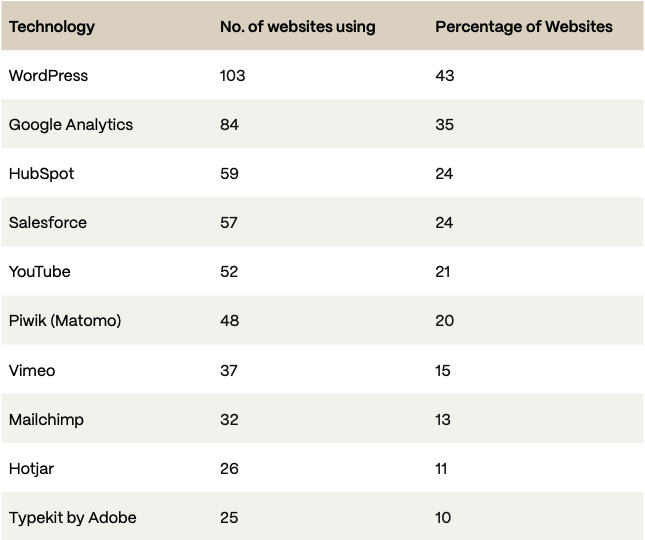
With YouTube (22 per cent) and Vimeo (15 per cent) in the top 10 tools, we’re pleased that some sustainability marketers see the power of video. But at least two-thirds of you are still missing a real opportunity to stand out.
Benefits of including video on your website include:
- Better conversion rates
- The ability to connect with a younger, video-first audience (who are quickly becoming decision-makers)
- Diversifying your content for impact
- Re-using video content across multiple platforms, e.g. social
Heatmaps for proven CRO impact
Sustainability is neglecting user feedback. Hotjar usage is only 11 per cent, indicating that sustainability marketers aren’t utilising heatmaps, feedback polls, and session recording to improve user experience and conversions. If your conversion rates are stuck in a rut and you’re not using heatmaps, you’re missing a trick.
Benefits include:
- Improving user adoption: Heatmaps, session recordings, and detailed analytics reveal where users drop off. Use these insights to improve your user journey and boost conversions.
- Refining stakeholder journeys: As more senior stakeholders get involved in buying journeys, tools like Hotjar help you A/B test messages, CTAs and information hierarchy for impact.
- Eliminating ego from website decisions: CRO tools help minimise doubt and navigate pre-existing website design and content bias.
Email isn’t dead: it’s evolving
On-site optimisation is only half the story. Nurture still does the heavy lifting for many sustainability buying cycles. Emailis a direct route to your audience and remains strong, even as platforms change. Only 13 per cent of sustainability websites use Mailchimp, but that doesn’t mean email marketing is over. Platforms like HubSpot and Salesforce have email functionality built into their CRMs.
According to Forbes, there are over 4.48 billion email users worldwide, and 88% of people check their emails daily. We’ll let you do the maths.
To make it count, focus on personalised nurture journeys instead of generic newsletters. And don’t forget the fundamentals:
- Make it easy to subscribe with clear CTAs
- Write snappy subject lines that readers can’t resist
- Always write with your ideal client in mind
Doing data differently: privacy, ethics and ownership
But measurement and compliance are shaping tool choices as much as performance is.
Google Analytics vs Piwik (Matomo)
35% of websites use GA, but 20% use direct competitor Piwik (Matomo). Piwik is an open-source web analytics platform offering website and app analytics, self-hosted and cloud-based hosting options, and integration with multiple platforms, tools, and CMSs. Key benefits include prioritising compliance and data control, with built-in tools that let users fully control where data is stored.
For sustainability marketers who want privacy-friendly analytics, this distinction matters.
- Tracking that connects user journeys across web platforms, mobile apps and digital devices provides invaluable insights for user experience
- The trade-off for accurate analytics? You must be accountable for GDPR, regulations, and standards related to environmentally relevant data, like carbon emissions and energy use.
AI integration in analytics
Accelerated AI integrations add to privacy considerations. Consider the following:
- Regulatory approvals: Data ownership is complex and regulations and reporting requirements evolve fast. With CSRD, CRI, SEC climate disclosures and more, consider a self-hosted data analytics platform.
- Regional readiness: Some platforms might make it easier to respect data residency requirements and disclosure rules in the EU, Canada, and the UAE.
- AI model training: A vendor’s small print might reserve the right to train AI using your data, increasing your legal and reputational risk.
- Site performance: More code means slower websites and more energy consumption. Lighter pages improve SEO and reduce your digital carbon footprint.
Make your martech stack work smarter
Whether you use all or none of the top 10 tools, there are lessons to be learned. For sustainability marketers in 2026 and beyond, it’s time to automate, integrate and prioritise governance and compliance. These are the foundations of your success.
If you do nothing else, start here:
- Choose a CMS and CRM setup that reduces integration friction (and the operational burden on your team)
- Invest in conversion learnings (video and user feedback) before doubling down on traffic
- Treat analytics as a governance decision, not just a reporting choice
Not sure where to start? Find out how we can help you with a free, no-BS marketing strategy review session.


.jpg?width=100&height=100&name=1694622801428%20(1).jpg)