No-BS Client Charter

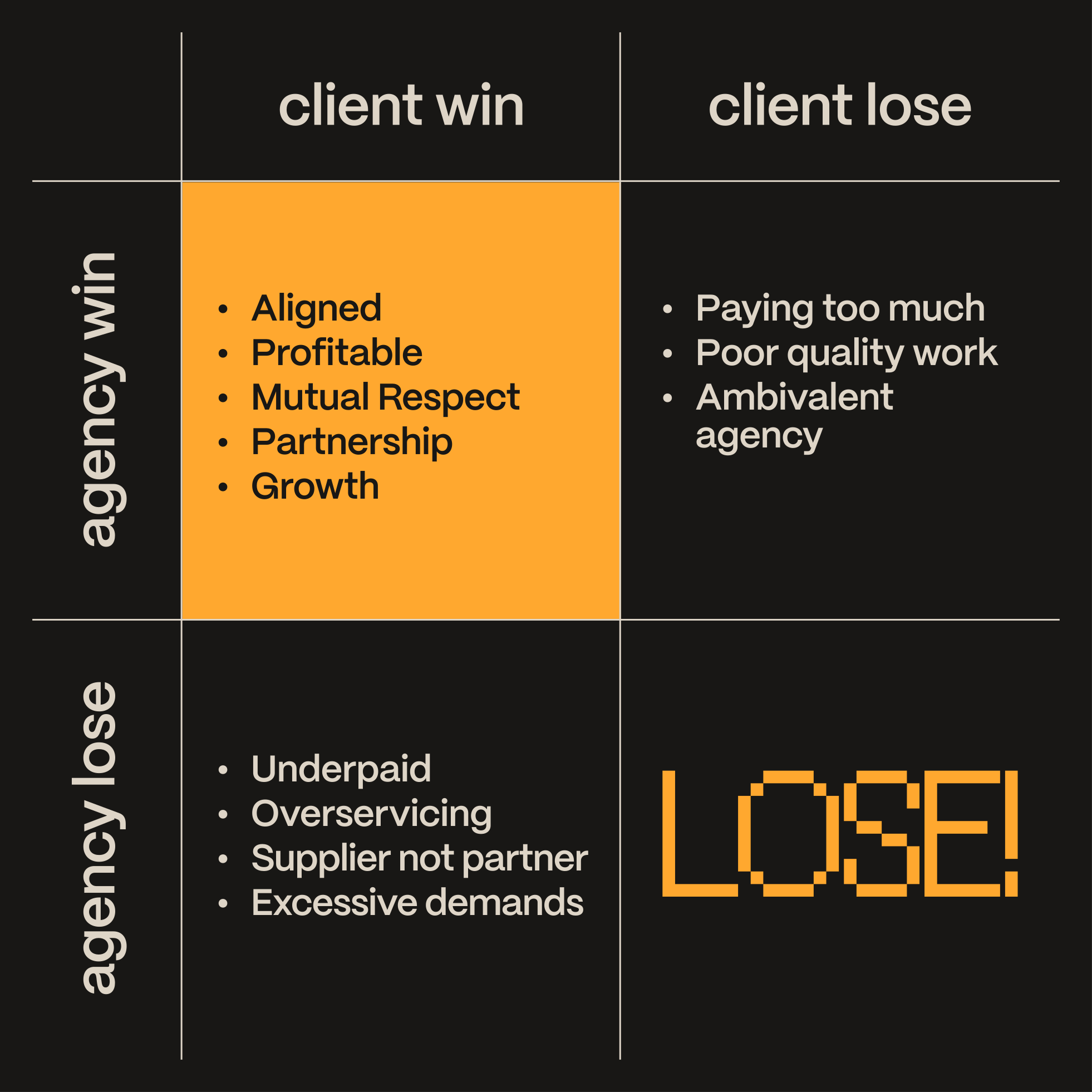
We are experts in our business. You are experts in yours. We aim to create a collaborative, transparent, respectful partnership. When we work together like this, we can achieve great things.

Collaboration
Divider decorative icon

About the client charter

Successful relationships start with mutual understanding. This charter explains what to expect from us, how to be a great client and get the best work from us.

To avoid wrapping it up in legal language, this charter does not form part of your contract. By analogy, it’s more like the Highway Code than the Road Traffic Act 1988.

See also: AI Policy for Clients

Divider decorative icon

The charter in a nutshell

We will

  • Provide a dedicated account manager, regular project management meetings, and proactive updates about milestones and deliverables.
  • Communicate with you via a dedicated group Slack channel and our project management tool, Notion.
  • Continuously improve our processes based on your feedback, tackling issues head-on.
  • Make recommendations based on data, analysis and our professional expertise.
  • Use ‘points’ to price, plan and schedule our work in weekly sprints.

You should

  • Be decisive with timely, consistent, and clear communications.
  • Give us good, consolidated, timely feedback when we ask for it.
  • Share helpful, relevant information and insights about your business.
  • Complete regular CSS surveys and share honest, respectful feedback about your experience.
No-BS Client Charter V3-1
Decorative supertitle icon Our goal and intentions

We want to build a successful, win-win partnership

To achieve this, our intentions are to:

  • Build enduring relationships
  • Be a trusted advisor and partner
  • Set the highest standards of professional service, respect, honesty and fairness
  • Understand your business
  • Align our services with your goals
  • Make recommendations based on data, analysis and our professional experience
  • Communicate clearly, regularly and effectively
  • Be clear and up front about costs
  • Address problems head-on and solve them constructively
Divider decorative icon

Client-centric Account Management

What to expect

We align with your team, brand and business goals. We commit to learning about your business. Here's how.

Party team clients

Placeholder

A named Articulate point of contact (aka project or account manager) who becomes your representative and client expert inside the agency

Placeholder

A dedicated client portal in Notion for access to your work

Placeholder

A shared Slack channel for regular communication

Placeholder

Monthly CSS to drive continuous improvement in our service

Placeholder

Periodic strategic reviews (‘Growth Plans’) to keep your goals in focus

How we learn about your business

You are the experts about your own business. We need to learn enough to do our work well. It’s an ongoing process.

Our work involves interviews, workshops and ideation as well as desk research. But we also do the following:


01

Sales handover document.

When a deal closes, sales writes a structured handover document for the studio.
02

Client immersion.

Most engagements start with a Brand Strategy phase, where we work with you to understand your business, what you sell, your customers and your market.
03

Client uploads.

Your client portal has an area where you can upload documents, presentations and other files. We also add things shared with us via Slack or email.
04

Brand strategy documents.

When we work on brand strategy, including messaging, personas, and positioning, we capture videos, notes, and finished presentations in your client portal, so the whole team has access.
Step decorative icon
05

Client Preferences database.

When we learn something about you, such as your writing or design preferences, that may not have been captured in our strategy work, we share it with the team. For example, we had a client who didn’t want us to use hashtags - ever. So that went into the database.
Step decorative icon
06

Growth plans

We revisit your business goals and our strategic recommendations at key project milestones, e.g. after a new website launch or quarterly for retainer clients.
Step decorative icon
07

Relationship Radar.

This internal database is where we log, monitor and (hopefully) work through client personnel and business changes, concerns, issues and complaints. The management team and studio review it every week.
Leaders team

Client Satisfaction Survey (CSS)

The CSS is a rolling monthly process of gathering feedback, reflection, learning and improvement. We aim for at least one submission per client per month, but receiving more feedback is even better. Anyone can submit a CSS survey at any time.

It will help us do a better job for you. If you tell us where there’s room for improvement, we’ll change things for the better. If you tell us what we’re doing well, we’ll do more of it.

It doesn’t take long to complete here: Client Satisfaction Survey

Towards the end of every month, we have an internal roundtable to review feedback and plan improvements. We will loop back to you with any follow-ups.

Divider decorative icon

Proactive project management

What project management looks like

  • Regular project management meetings to keep you in the loop
  • We’ll track your work - milestones, deliverables and tasks - in our project management system

How we like to communicate

  • Your primary point of contact is your project manager. Their contact details are in your client portal
  • We use Slack as the primary channel of communications. We will set up a shared channel and prefer open communications there to DMs.
  • We like feedback on work via Notion comments. Always let us know when you’ve finished reviewing something.
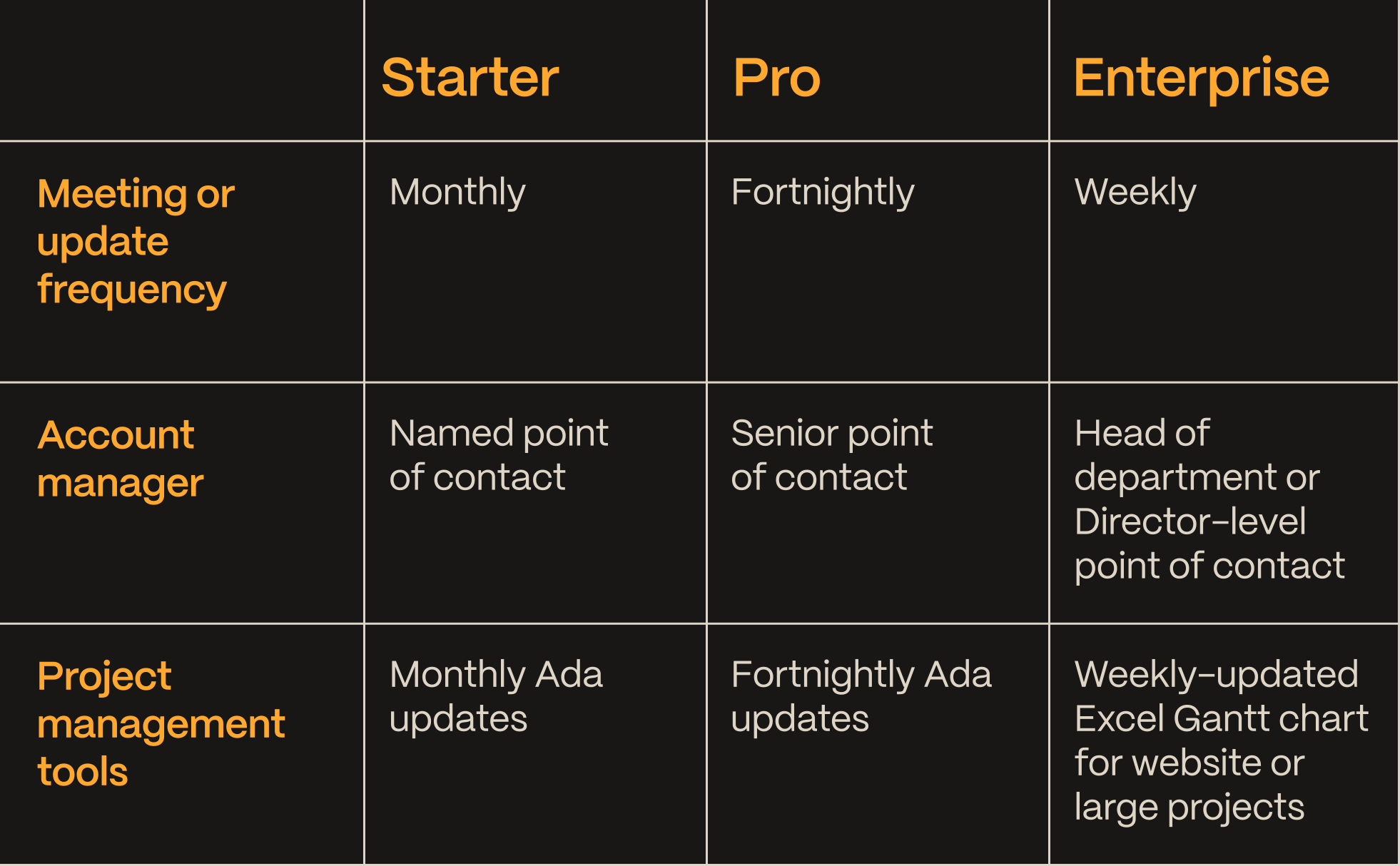
  • We will have regular project management meetings (weekly, fortnightly, or monthly, depending on the level of our engagement). These meetings are an opportunity to share updates, review progress and schedules, and check in on dependencies. We will try to share the agendas in advance.
  • We keep our cameras on during meetings, and we would prefer it if you did, too. Seeing faces improves communication.
  • We usually record meetings and sometimes use AI tools to summarise them. We share notes and recordings with you in your client portal.

Project management tiers
Decorative supertitle icon Project management tiers

We match the project management tier to the highest tier of the work we are doing for you in any given month. This means that you can move up or down a tier over the life of an engagement. This table summarises the main differences between tiers.
Project management SLAs
Decorative supertitle icon Project management SLAs

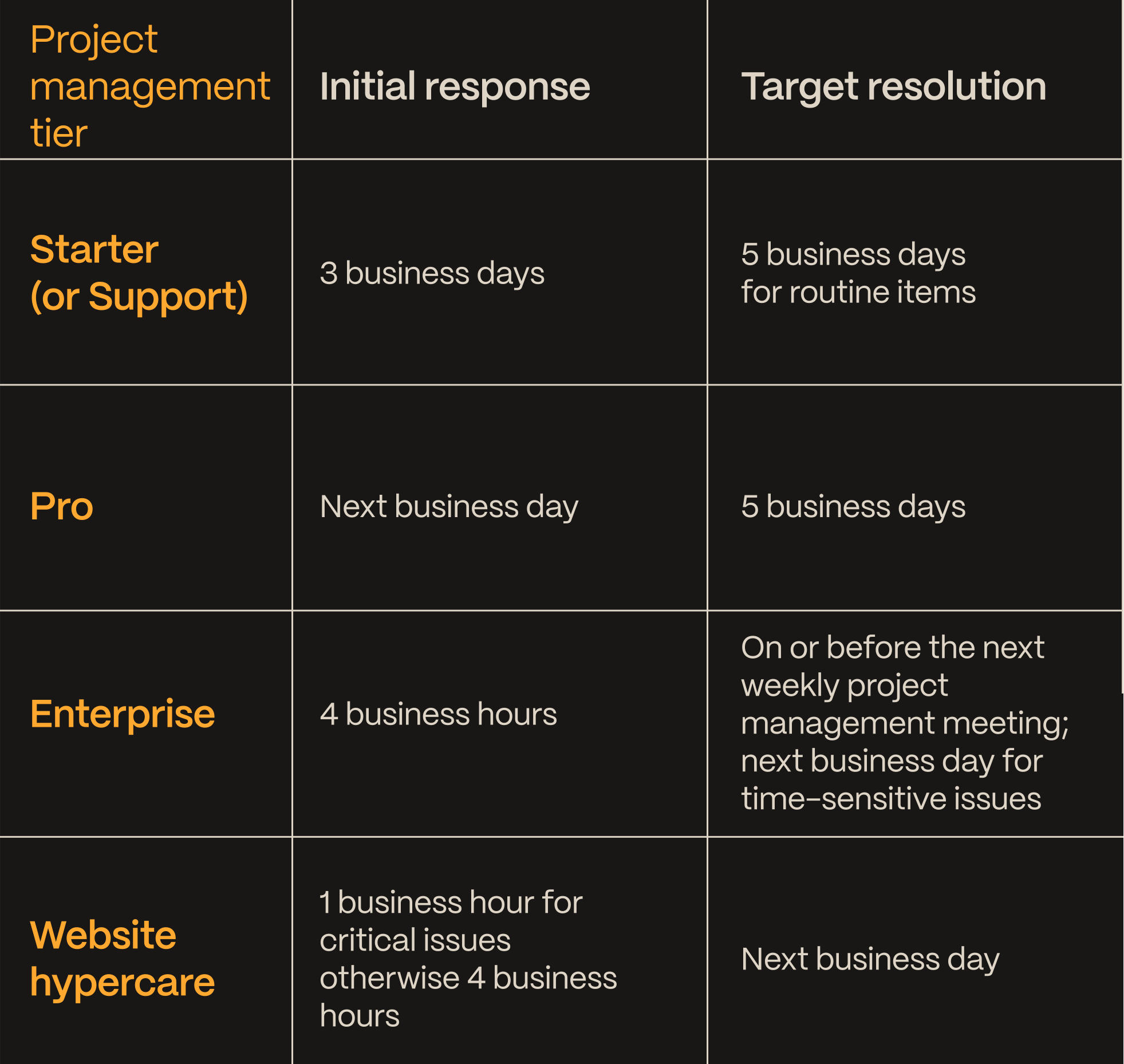
The SLAs are based on requests sent via Slack to a shared channel, emailed to clients@articulatemarketing.com or added to a post-launch website issues database. Other channels may not be monitored as closely.

Business hours and Business days mean 09:00-17:30 UK time, Monday-Friday, excluding public holidays.

Resolution is when an answer/plan of action is agreed not necessarily when work is fully delivered. For example, we may agree a plan to brief into the next weekly sprint.

Website hypercare runs for five working days after the launch of a new website.

Critical issues relate to anything that prevents access to the website or core functionality for most users.


After our engagement finishes

When an engagement comes to an end, for example, after we finish a new website or at the end of a retainer, we aim to manage the wrap-up professionally. Specifically:

  • We will agree a timetable to complete any remaining work and use up any remaining points.
  • We will agree with you on which project management tier is most suitable for ongoing work. Unless otherwise agreed, we will move to the Starter SLA, cancel ongoing project management meetings and charge for project management on a time-spent basis according to our hourly rate card.
  • Once any remaining work is finished, we will archive your client Notion portal and shared Slack channel.
  • We will continue to give you access to your Notion client portal for at least six months.
  • We request that we keep at least one user in your HubSpot portal. This helps us with HubSpot partner tiering and also enables us to respond quickly in the event of an emergency request. We will remove non-essential users, and HubSpot won't charge you for partner seats.

Divider decorative icon

How ‘points’ work

What is a ‘point’?

A point measures the effort, time, and expertise required to deliver our work. It is primarily an internal planning unit and a method of pricing work.

Divider decorative icon

Points are:

01

Fungible.

Points you buy can be used interchangeably for any of our services. The main exceptions are fixed-price projects and website maintenance or HubSpot-specific engagements, where points can only be used for the specified services.
02

Quotable.

We can price and quote work quickly based on internal effort estimates or our tariff of fixed-price deliverables or give you an hourly rate where it is more difficult to estimate the work in advance.
03

Flexible.

Points give us a flexible and transparent way to adjust our priorities and plans to meet your evolving needs.
04

Predictable.

Your costs are predictable, even if the work we do with your points varies month by month.
Step decorative icon
05

Visible.

Our prices and service costs are transparent so you know in advance what your deliverables will cost.
europeana-9QbJKqVFOgc-unsplash
Divider decorative icon

What are the different use cases for points?

01

Fixed price deliverables.

For example, a blog post or building a landing page or creating an illustration where we have a pre-agreed fixed price. See Points Tariff.
02

Cost tracking on fixed-price project.

Even if we aren’t quoting the project on a points basis, we use points internally to measure time, profitability and track overservicing.
03

Fixed price, variable quantity.

Where we have a fixed price per item but we don't know how many items. Often we create a provisional budget and draw down. For example, page building for a website.
04

Project management.

Covers attendance at meetings, routine emails and so on. Points per month vary according to the engagement tier as described here: @Project management tiers.
Step decorative icon
05

Website optimisation sprints.

We create a prioritised backlog for SEO, CRO or CWV technical changes. We charge a fixed price in points for 1 day (8 hours) of specialist work over the course of a sprint, including planning and writing a POE document. We complete tasks from the plan in order of priority.
Step decorative icon
06

Hourly work.

Where we don't know how long something is going to take but we know who is doing it. Used if any of the preceding models don't fit. Tiered rate based on the person's seniority needed to do the work. For example, HubSpot support requests, out-of-scope work and rounds of revision, ad-hoc website maintenance or consultancy requests.
art-institute-of-chicago-srEIl5A91TQ-unsplash

Points FAQs

Close all tabs

Are points the same as hours?
01

No.

We don't do timesheets and we don't quote hourly or daily rates.

As a rough rule of thumb, on a blended rate basis, one point is approximately equivalent to 30 minutes of work. However, we have a tiered rate for hourly rate work and for tariff deliverables. For fixed-price and sprint day work, the price is fixed in points, as is the scope.

An answer that didn't really help

Do unused points 'roll over' from one month to the next?
02

Yes.

And we can also 'borrow ahead' in some cases.

But where possible, we prefer to align resource allocation with spending, at least quarterly, and there are different conditions after a contract has ended.

How does Articulate track points?
03

We use Ada - our own project management tool. We operate a three-tier system:

  • Workstreams (e.g. website design, this quarter's retainer)
  • Deliverables (e.g. a blog post, module coding, logo design)
  • Tasks (i.e. the actual work assigned to different team members to produce the deliverable).

We assign tasks on a weekly sprint basis on Thursdays for designers and coders and on Mondays for writers and strategists. We also have tools to track utilisation, capacity and output KPIs for internal purposes.

How to be an excellent client and get our best work

Close all tabs

Be decisive and responsive
01

You can help us deliver projects on time by promptly arranging meetings, making informed decisions, providing timely feedback, and supplying necessary assets.

An answer that didn't really help

Engage with our process
02

  • You hired us for our expertise and know-how. (Thank you!) Much of that is embodied in our Difference Engine processes.
  • Working with our existing processes and systems rather than reinventing them is more efficient, and allows us to do better work.


Keep us in the loop
03

  • Please tell us about changes in your team. We are happy to run ‘Introduction to Articulate’ calls for new people.
  • Likewise, please tell us about changes in the business and marketing plans. This helps us support you more efficiently.

Giving feedback on work
04

  • Please add comments in Notion or Figma. This helps us review and resolve feedback in the places where we work.
  • Let us know when you have added all your feedback so that we know when the ball is back in our court.
  • Try to batch feedback so we can process it efficiently.
  • If you have multiple stakeholders, it’s helpful if you have a feedback coordinator to consolidate the feedback, ensure consensus and alignment and give us a single point of contact
  • We appreciate timely feedback to keep our projects running smoothly. Getting your notes within the agreed timeframe helps us deliver amazing work on schedule.

To err is human, to feedback divine
05

  • Positive feedback is hugely motivational; tell us what we did well and we’ll do more of it.
  • We're not shy about constructive feedback, but we're human beings and we have feelings. Please be considerate and courteous when providing feedback.
  • We’re only human. Sometimes, we make mistakes, sometimes we have too much on our plate, and sometimes we forget things. It’s fine to let us know if this happens so we can sort things out.
  • If you have a more serious concern or problem, your account manager is the first port of call. The Client Satisfaction Survey is ideal for more general feedback about Articulate as a whole. In some (hopefully) rare cases, you may feel the need to escalate your concerns to the business's directors by emailing ceo@articulatemarketing.com. We also have a formal grievance policy, which includes provision for external complaints.
  • We will not tolerate bullying or harassment.

Understand our working patterns
06

  • We understand that last-minute rush jobs sometimes occur, but try to avoid making them a habit. Creativity hates a crisis, and we value work-life balance.
  • We work flexibly and across different time zones, and many of our clients do the same. We will try to keep people’s schedules and time zones in mind when communicating with you. We hope you will do the same.
  • We plan our work in weekly sprints, and there is a regular cadence of internal team meetings. This means that we might not respond immediately to a request because we need to schedule the work or discuss it with colleagues. Rest assured, we will contact you as soon as we have an answer.
  • Approval of contract changes and non-trivial out-of-scope work rests with directors at Articulate. Such requests are only approved once you have received written confirmation.