Posted by
Sam Beddall
Your website now has two audiences. One is human. The other is made up of AI bots, search crawlers and answer engines. The uncomfortable possibility is that one of those audiences may not be able to see the site properly.
Human visitors still matter most. A website that does not help buyers understand you, trust you and take the next step has failed, however clever the technical setup may be. But buyers are increasingly using tools like ChatGPT, Claude, Perplexity and Copilot to research suppliers, compare options and prepare questions before they speak to sales.
That means your website may be read, summarised or judged by AI systems long before a person lands on the page. If those systems cannot access your content, parse it or understand what you do, you may be absent from the conversation before the buyer has even made a shortlist.
AI visibility is a fast-moving mix of technical, editorial and governance questions. Can the right crawlers reach your site? Is the content available in clean HTML? Does the page load quickly enough? Is the information structured clearly? Are your claims supported by visible, current content?
There are plenty of shiny shortcuts being sold around AI search. Most are less useful than they look. The stronger answer is more practical and less glamorous. Build a fast, accessible, standards-compliant website with clear content, good structure and a deliberate approach to AI crawlers.

Ranking well and being read are different achievements
For years, website visibility mostly meant being found in Google. That still matters, but AI search has changed the mechanics of discovery. A page can perform in traditional search while still making it difficult for AI systems to fetch, parse or quote.
The deck puts this neatly. Ranking well and being read are now two different achievements. A buyer may ask an AI tool to recommend suppliers, compare vendors or explain who is credible in a category. The answer may be shaped by what AI systems can retrieve and understand from your site and from the wider web.
Traditional SEO still helps. Page structure, useful content, internal links, performance and authority have not gone away. But AI search is more likely to retrieve passages, compare information and cite sources inside a generated answer. It may not process your page in the neat sequence your design team intended.
That changes how content needs to work. Important sections should be clear enough to make sense when quoted or summarised on their own. Headings need to signal the question being answered. Facts should appear in readable text, not only in PDFs, images, videos or JavaScript-loaded modules.
A website has to work as AI source material while also providing a great human experience.
AI bots do different jobs
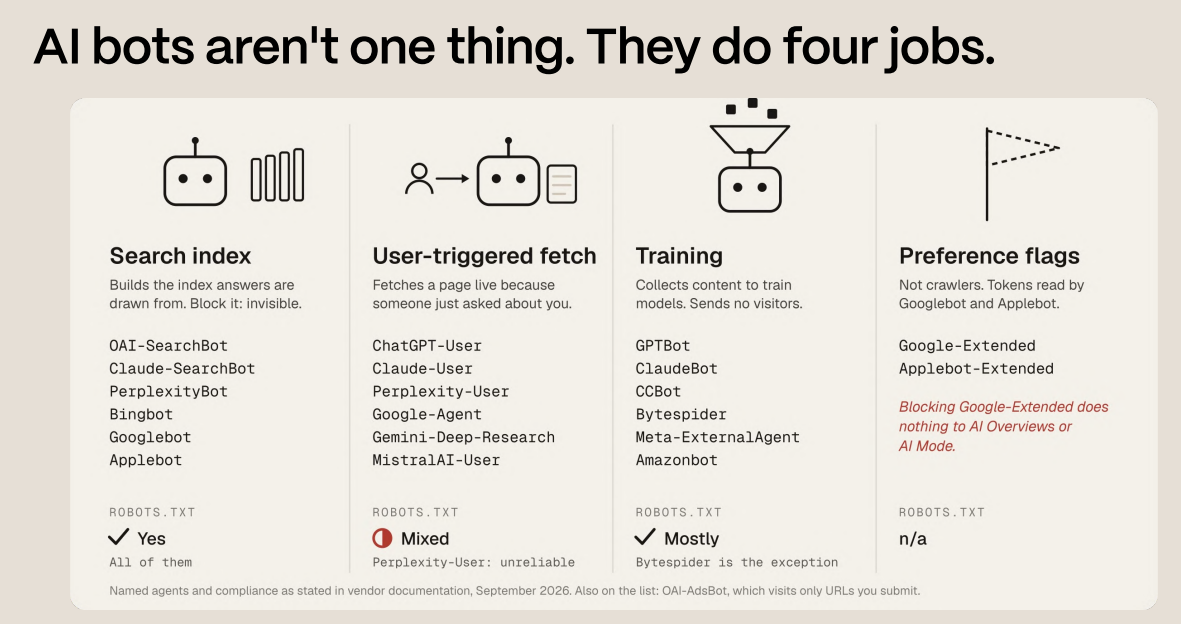
AI visibility can sound like one problem, but AI systems interact with websites in several ways. Some bots build search indexes. Some fetch pages in response to a user’s prompt. Some collect material for training. Others act as preference flags, such as Google-Extended, which affects training rather than AI Overviews or AI Mode.
You may want different rules for each of those activities. A B2B company might choose to allow AI search bots and user-triggered fetchers while making a separate decision about whether its content can be used for training. Those choices should be intentional, not inherited from old settings or buried in a CDN dashboard.
A few years ago, many organisations became nervous about AI companies scraping their content to train models. Some responded by blocking AI bots. Now AI search is becoming part of buyer research, those rules can create accidental invisibility.
Robots.txt, CDN settings, firewall rules and hosting configurations all play a part. They may block useful crawlers, allow the wrong ones or treat training bots and search bots as though they are the same thing. The first task is to understand what your site currently permits, then decide whether those rules still make sense.
Check whether you are blocking AI crawlers
One of the easiest AI visibility checks to miss is also one of the most basic. Can AI crawlers access the pages you want them to read?
The answer may be no. Some sites block AI crawlers through robots.txt. CDN or security settings restrict some. Some use legacy rules created when the only concern was AI training. The deck cites analysis suggesting that one in four B2B websites may block AI crawlers without knowing it.
That means the problem may not be weak content. It may be a rule someone switched on months ago, or a default setting nobody has reviewed since.
For many B2B websites, the starting point should be to allow AI search bots and AI fetchers where appropriate, then make a separate decision about training access. Search access and training access are different policies, and treating them as one blunt decision can create the wrong outcome.
Ask your team to review:
- Robots.txt rules
- CDN bot settings
- Firewall rules
- Security plug-ins
- AI bot allowlists and blocklists
- Search crawler access
- Whether search bots and training bots are handled separately
Do not assume everything is fine because Google can crawl the site. Google is no longer the only reader that matters.
Do not hide important content behind JavaScript
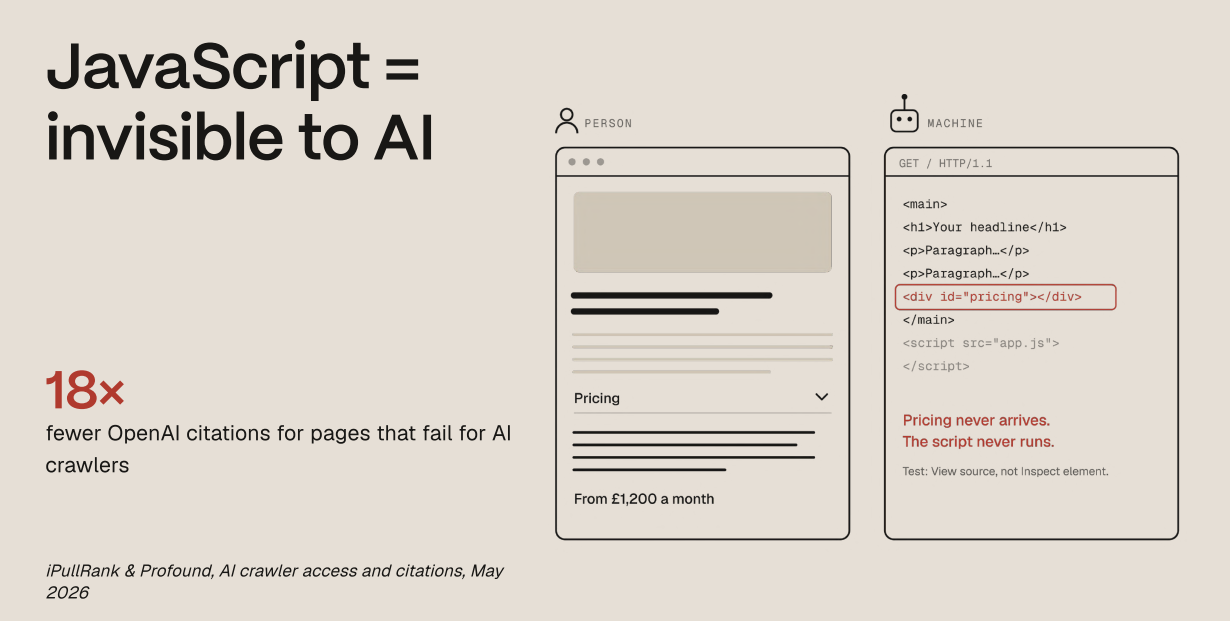
No major AI crawler reliably runs JavaScript in the way a browser does. That creates problems for websites that rely heavily on React, client-side rendering, dynamic modules or JavaScript-loaded content.
The page may look complete to a human visitor, but an AI crawler may see very little useful information. Think of it like delivering an IKEA box. The browser assembles the sideboard. The AI bot may only see the parts in the box and move on.
This can affect whole pages, but it can also affect small pieces of important content. Pricing, product details, testimonials, forms, comparison information or proof points may be pulled in dynamically. If that information only appears after the script runs, the machine-readable version of the page may miss the exact details a buyer cares about.
Modern web technology is not the enemy. It just needs to be used carefully on marketing websites. Core content should be available in clean HTML, including headings, body copy, pricing where appropriate, product or service information, FAQs, tables, links and calls to action.
Animation, interactivity and visual polish can all have a place. They should not stop the site doing the more basic job of being readable.
A page can look complete to a person while hiding key information from an AI crawler. If pricing, product details or proof points only appear after JavaScript runs, the machine may never see them.
Speed is now an AI visibility issue
Fast websites have always been better for users. They support conversion, accessibility and SEO because people do not enjoy waiting for bloated pages to load. AI crawlers make performance even more important.
Search bots and AI fetchers may not wait around for slow pages, long redirect chains or heavy scripts. If the site takes too long to respond, the bot may leave. Traditional SEO tools can often tell you when Google has a problem. With AI systems, the missed opportunity may be much harder to see.
Performance should be treated as part of AI readiness. Measure time to first byte. Look at redirect chains. Fix 404 errors. Remove unnecessary scripts. Use field data, not only lab scores. Keep the HTML lean and standards-compliant.
The basics are familiar:
- Clean HTML
- Real headings
- One H1 per page
- Real tables where tables are needed
- Real buttons and links
- Alt text for images
- Minimal unnecessary JavaScript
- Short redirect paths
- Lightweight images
- Accessible page structure
None of this is esoteric AI optimisation. It is good website practice with another commercial reason behind it.
Machines lift passages, not pages
For years, many marketers were told that longer content performs better in search. That advice encouraged a lot of 1,500-word posts stretched beyond what the topic deserved.
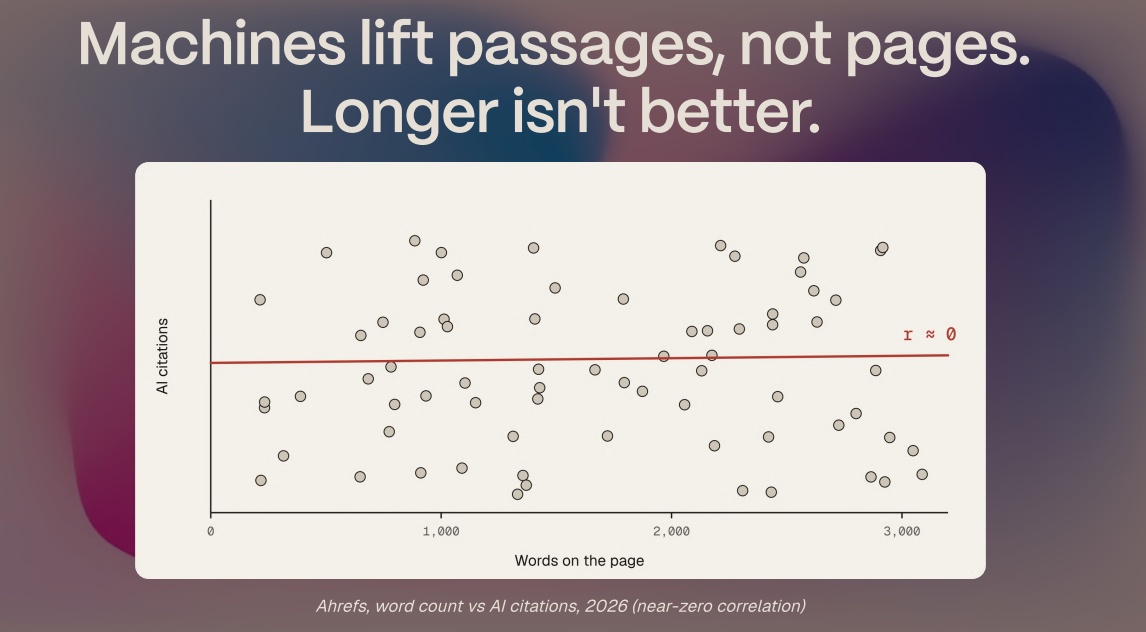
AI search changes the calculation. The deck puts it neatly: machines lift passages, not pages. Recent Ahrefs analysis cited in the webinar found near-zero correlation between page word count and AI citations, which means longer pages are not automatically more likely to be cited by AI systems.
Length still has a role when a topic needs depth. The mistake is treating word count as the goal. A clear 300-word section that answers a buyer’s question may be more useful for AI visibility than a padded article built around an old SEO habit.
For AI visibility, useful page sections often follow a simple shape. Lead with a question-shaped heading. Give a short answer first. Then provide evidence, examples, definitions or comparison.
Each section should be able to stand on its own because AI systems may pull a passage rather than summarise the whole page. Facts should be in the text, not buried in images, PDFs or videos.
Formats that often help include:
- Numbered lists
- Clear definitions
- Comparison tables
- FAQs where the questions are genuine
- Original data
- Concise explanations followed by evidence
- Pages that answer a specific buyer question
Write for people first, but structure the answer so machines can parse it.

Keep important pages genuinely current
AI systems appear to favour current content. The transcript notes that a significant share of AI-cited pages have been updated in the last six months, with several studies pointing in the same direction.
Changing the date on an old article is not enough. The content itself needs to be reviewed, improved and brought up to date.
For a B2B website, that means paying attention to the pages that carry your commercial truth. Service pages, product pages, comparison pages, pricing pages, case studies, guides, sector pages and FAQs all need to reflect what the business actually does now.
Old content can still have value, but content drift creates risk. The more pages you have, the easier it becomes for outdated claims, retired offers, stale statistics and old positioning to remain online. AI tools may find and use those fragments.
A smaller set of strong, current pages is often healthier than a sprawling archive of thin variants. One strong page beats five weak ones, especially if those five pages are mostly keyword variations saying the same thing.
Ungate useful content where machines can read it
Many B2B teams still treat long-form content as bait. Hide the useful material behind a form, capture the lead and let sales follow up. That model can still have a place, but it creates a visibility problem when the best thinking is trapped inside a PDF or hidden behind a gate.
AI systems may not be able to read it. Human buyers may also leave before they understand why the asset is worth downloading.
A more useful model is to publish a strong ungated version on the website, then offer the same material as a downloadable PDF for people who want to save, print or share it. The page gives search engines and AI systems something useful to parse, while the PDF still gives visitors a reason to convert.
This does not have to mean giving away value without any commercial return but rather letting people see enough of the thinking to trust it, then offering a useful format to take away.
Schema helps machines stop guessing
Structured data is still useful, but it should not be sold as a shortcut to AI visibility. Google has said structured data is not mandatory for AI features and there is no AI-specific markup that guarantees visibility.
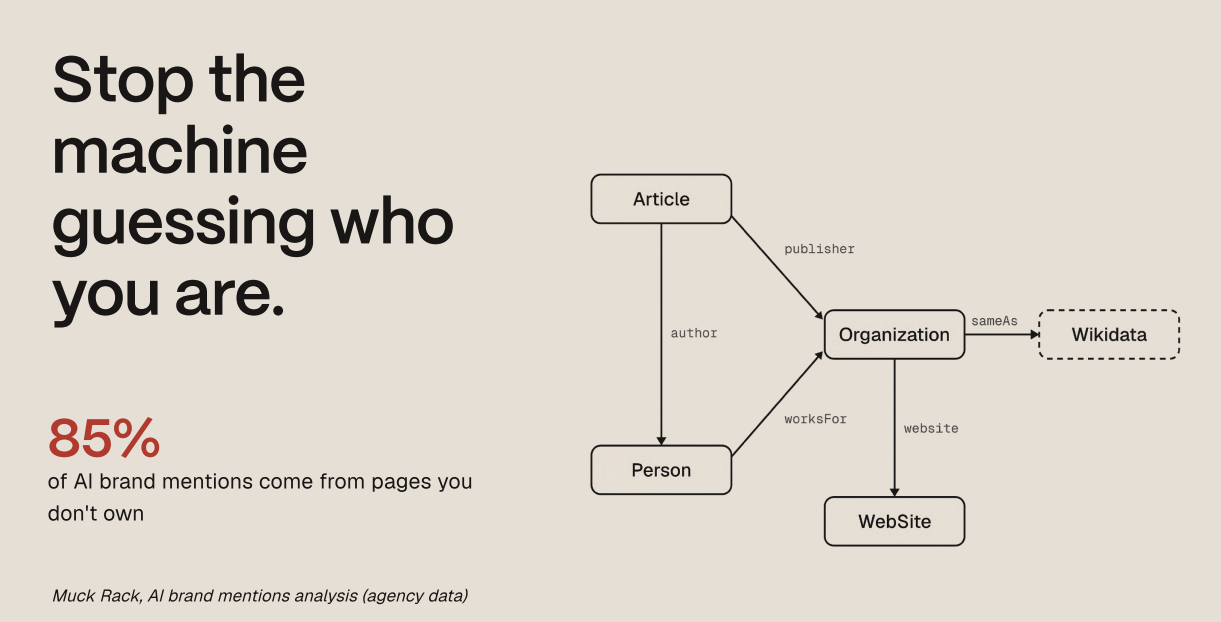
The value of schema is clarity. It helps machines understand what information means and how different entities relate to one another. For B2B websites, that may include organisation schema, person schema, service schema, product or offer information, articles, videos, FAQs and events.
The richer opportunity is to build a semantic graph that connects the business, its people, services, content, proof points and external profiles. An article can be connected to its author. The author can be connected to the company. The company can be connected to LinkedIn, Wikidata, Crunchbase, review sites, YouTube and other credible external sources.
That gives machines a clearer picture of the relationship between your website and the wider evidence around your brand.
Schema must also be honest. Any claim made in schema should appear visibly on the page. Using structured data to hide claims, stuff keywords or mislead crawlers creates risk rather than visibility.

Accessibility is agent readiness
Accessibility is often framed as a moral, legal or user-experience issue. It is all of those things, and it is increasingly relevant to AI visibility as well.
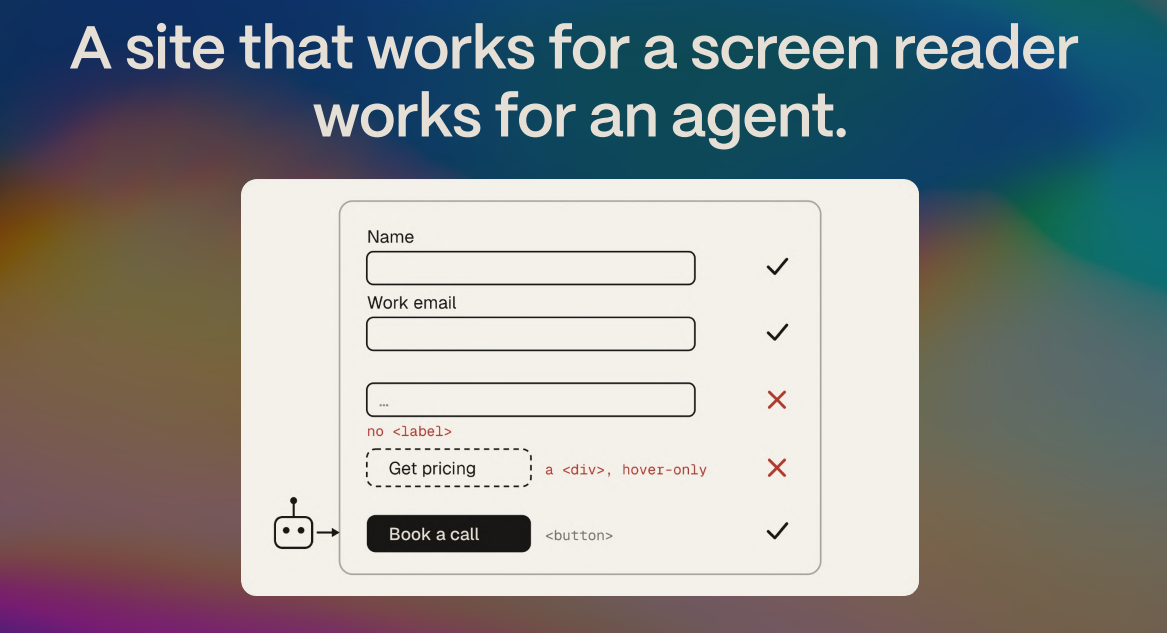
A site that works for a screen reader is more likely to work for an agent. Poor labels, hidden content, confusing structure, missing alt text, inaccessible controls and non-standard markup all make a page harder for machines to interpret.
Running a WCAG 2.1 AA audit can help you see the site differently. It is a way to check whether people can use the site, but it also gives clues about whether machines can understand and navigate it.
This will become more important as AI tools move from reading websites to using them. Agents may start helping users compare options, complete forms, request quotes, book meetings or move through buying journeys.
If a website is difficult for machines to use, that can become a commercial problem as well as an accessibility problem. Clear structure, good labels, accessible controls and clean HTML improve the experience for users, search engines and AI systems.

Beware of AI visibility shortcuts
AI visibility is moving quickly, and that makes it attractive territory for vendors selling expensive shortcuts. Some tactics that sounded promising last year now look much less useful.
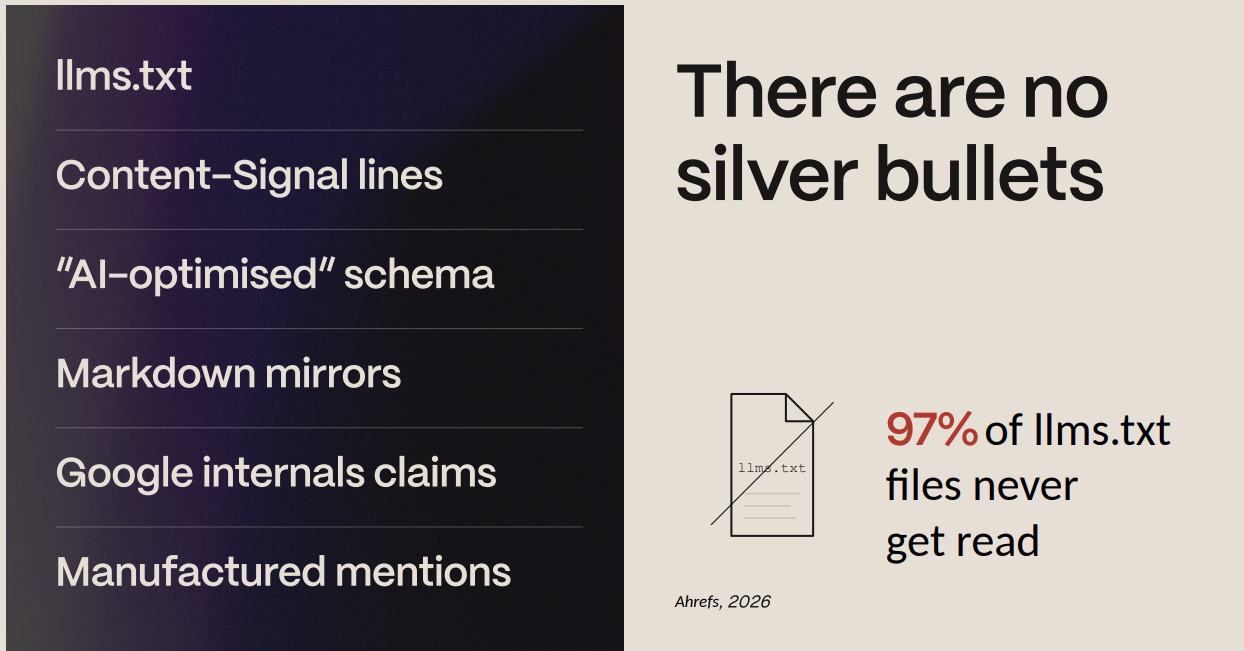
The transcript highlights several approaches that Google has said do not matter for its AI features. These include LLMs.txt, AI-specific markup, automatic markdown versions of pages, writing specifically for AI, chasing long-tail variations and manufacturing mentions.
Some of these tactics may not actively hurt. Others may waste time and budget. The bigger problem is that they distract from work that is more likely to help.
LLMs.txt is a good example. It may be easy to add, and it probably does not hurt by itself. But evidence cited in the webinar suggests that most LLMs.txt pages are never visited by bots. If a vendor wants to charge thousands a month for a system built around that kind of approach, ask careful questions.
The same applies to fake community posts, seeded reviews and manufactured mentions. Search systems are becoming more explicit about spam and manipulation. Trying to game AI visibility may backfire.
Be especially cautious of anyone claiming inside access to Google’s systems. Google has repeatedly said that nobody outside Google has access to its internals.

What seems to work
The sensible path is not mysterious. Most websites will benefit from the same improvements that already support accessibility, usability, conversion, SEO and good content strategy. AI visibility adds urgency, but it does not overturn the fundamentals.
A practical approach would include:
- Allowing AI search and fetch bots where appropriate
- Separating search access from training access
- Checking robots.txt and CDN settings
- Serving core content in clean HTML
- Reducing JavaScript dependency for important copy
- Improving time to first byte and overall performance
- Fixing redirect chains and broken pages
- Using accessible, standards-compliant markup
- Writing clear sections that answer real questions
- Putting important facts in readable text
- Using numbered lists, definitions and comparison tables where helpful
- Updating content properly, not just changing dates
- Ungating useful material where visibility matters
- Adding honest, valid schema
- Connecting people, services, articles and external profiles
- Maintaining profiles on credible third-party sites
- Measuring what you can before making changes
AI visibility is not won by one clever file, one plug-in or one expensive platform. It is won by making the site easier to access, understand and trust.
Ten checks you can run this week
You do not need to begin with a huge transformation project. A focused audit can reveal whether the basics are working.
- Fetch your homepage as an AI bot
See what comes back and whether the important content is visible. - Review robots.txt on every subdomain
Check whether search bots, AI fetchers and training bots are being handled deliberately rather than blocked by accident. - Open your CDN and security settings
Look for rules that may be stopping useful crawlers before they reach the site. - View source on your top pages
Check whether key content is available in clean HTML, or whether it only appears after JavaScript runs. - Measure time to first byte
Test performance from the markets that matter to you, not just from one local lab report. - Review your core content
Ask whether important pages answer real buyer questions, put facts in readable text and use headings that make sense on their own. - Look for hidden content
Identify important information trapped in PDFs, images, videos or dynamic modules that AI crawlers may not read. - Validate your schema
Make sure structured data is accurate, visible on the page and still working after template changes. - Set up Bing Webmaster Tools
If you have not already done this, upload your sitemap. Bing matters more now because of its connection to Copilot and AI search. - Review AI referral and visibility signals
Use Google Search Console, Bing Webmaster Tools, analytics and your CRM to track what you can, while remembering that direct AI referrals may only show part of the picture.
The well-trodden path is still the best one
AI search is new enough that everyone is still learning. Recommendations will keep changing, and some of today’s fashionable tactics will look wasteful in a few months. That uncertainty can make people anxious, which makes them vulnerable to overcomplicated answers.
The best response is to return to the fundamentals with a sharper understanding of the new audience reading your site.
Make it fast. Make it accessible. Make it readable. Make it useful. Make it current. Make it structured. Make it trustworthy.
AI visibility grows out of good website practice. If your competitors are still building slow, overdesigned, JavaScript-heavy sites full of vague copy and hidden PDFs, you do not need a silver bullet.
You need a better website.

Want to know if AI can see your website?
There is no magic file for AI visibility. The work is making your website easier to access, understand and trust.
Book a free 30-minute Marketing Strategy Session with Articulate founder Matthew Stibbe. We’ll look at whether your site is visible to AI search, where the technical gaps may be and what to fix first.