Posted by
Ioana Negulescu
Last year, someone asked me (Ioana) to organise a Christmas market. The brief was a list of 50 contacts for potential exhibitors and vendors, a location and one instruction: go away and do it.
Was it the most brilliant brief she has ever received? To a degree, yes. It told her she was trusted to make the decisions, and that she could ask for whatever she needed when she needed it.
This article is based on a webinar that Ioana and Matthew Stibbe ran recently. You can watch the video here.
We have worked together for about a decade on more than 120 websites, and almost no website brief we receive looks like that one. Most are long, anxious and precise about the wrong things. Some run to 20 pages. A few specify how the buttons should move when you hover over them.
So here is our view, formed the hard way. The best website brief is short on everything except a few critical inputs, such as the project's goals, brand guidelines, decision-making, integration requirements and where the copy is coming from. It is honest about what you don't know. And you could recite it if someone woke you at 3am.
Most briefs are written for the wrong reader
"Most of the time the brief is written for the CEO," said Ioana. Its job is to get the project approved, unlock the budget and let the marketing team pick an agency. That is a fair thing to need. But a document written to win sign-off fills up with the preferences of the people who run the business. What your customers want to see, read or find on the site gets left out.
The other kind is the over-engineered brief. Ioana's diagnosis is that these "come with a bit of a trauma from past projects". A previous build went wrong, so this time everything is nailed down in advance: the sitemap, the page structures, the hover effects. We understand the instinct. Website projects carry a lot of psychological baggage.
Matthew sees the same thing from the commercial side. When clients are anxious, they want control. But a brief that claims to know everything leaves no room for what the other side might bring. "Nobody in the world can write down a list of things they don't know," he said.
There is a practical cost too. If the brief arrives with every decision made, we spend the project talking people out of some of them. We would sooner do the strategy work and present it with our reasons.
A new website is necessary, but not sufficient
Nearly every brief says the new site should bring in more leads. Matthew agrees that it should. Your website is probably one of the most important commercial assets you have. If it doesn't convert, misrepresents the brand, breaks on a phone or can't be found in search, fix it.
But a new website on its own rarely brings more traffic and more leads. "It's necessary, but not sufficient," said Matthew. His analogy: people think repainting the car will make it go faster.

The tell is a brief that goes deep on aesthetics and rearranging the furniture and says nothing about commercial goals: what a deal is worth, what the pipeline looks like, what the current lead rate is. Not every brief needs those numbers. But if they are missing, expect questions. Suppose we build you a site that is technically sound for search and AI discoverability. Who produces the content that makes it work? The website does part of the job. Content and social do the rest. A site can look great and still not convert.
Bring questions, not a sitemap
Sitemaps drawn in PowerPoint are a familiar sight. Sitemaps in Excel are, as Matthew put it, "always a tell". The message is: these 38 pages and no others. Yet whether you need more pages or fewer is one of the things you are paying an agency to work out.
Page count used to matter more. It drove the price, because every page meant copywriting, building and illustration. That link is weaker now. On HubSpot, and with the way we now iterate on code, copy and design together, the number of pages is much less relevant than it was.
A sense of the complexity helps more. Tell us you are a software company with 20 product lines and 15 audiences. Or tell us you don't understand your audiences yet and want help. Tell us you suspect you need fewer pages. Matthew's advice is to arrive with "more questions than definitive answers".
That is not an argument for a blank page. An empty brief means the agency asks all the questions and you end up writing one together anyway. A little preparation shows where you already know your stuff, so we can move through it fast, and where we need to bring more of our own experience. An in-house marketer might work on two, three or four websites in a career. We spend all our time thinking about them.
Use your words for the technical details
Here is the gap we see most often, only slightly exaggerated: ten pages on button animation, then one line saying the site needs to integrate with the e-commerce system.
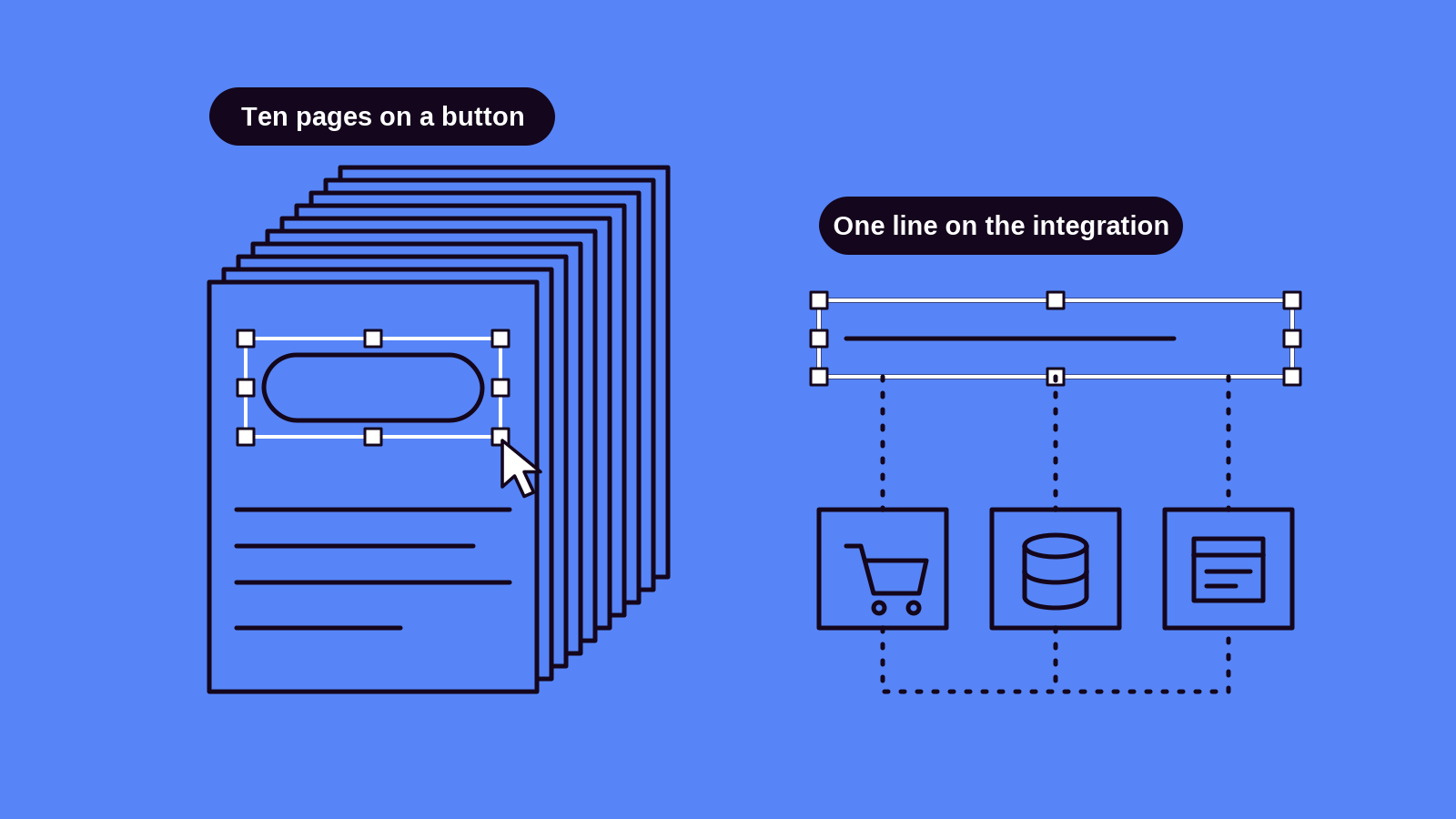
That one line is the expensive one. An integration can be a ten-minute automation that takes an email from one place and puts it in another. It can also be a deeply complicated customer portal. It is the hardest part of a website to scope and price, and it often surfaces in discovery when it should have been in the brief. Ioana could live without a brief altogether, as long as she knew the technical requirements.
Matthew goes further. A website is no longer a pretty brochure with a little search optimisation behind it. It is how people interact with your business. So a brief with no integration requirement at all, not even to your marketing automation, is "a huge red flag".
Two more things belong here. By Matthew's estimate, about one brief in 20 says anything about accessibility or load speed. If you have goals for either, say so. And if you want the new site to be discoverable by AI search, which is the latest fashion in briefs, find out what that means in practice. We have ten questions you can ask.
Decide who writes the copy and who signs it off
For the last couple of years, our website projects have very rarely run late because of design or code. They run late because of copy. The client planned to write it and ran out of time. Twenty thousand words that fit the page and work for search are hard to produce when your marketing team is already overworked. So say in the brief where the copy and the images will come from, and plan for the writing first.
The other cause of delay is the absentee landlord: the senior person who hands over the project, then turns up at the end and wants it to look more like Apple. Matthew's fix is to put a RACI chart (responsible, accountable, consulted, informed) in the brief. Give everyone a box and check they are happy in it. If the CEO might overrule the colours at the last minute, the CEO is in the wrong box.
Don't let the RFP write the brief
About one brief in five that Matthew has seen was written for a request for proposal (RFP), and they share a pattern. They over-specify the work so that every agency can return a price. Then the decision is made on price and on which pitch the highest-paid person in the room likes the look of.
That tells you little about what matters. Is the agency creative? Will it challenge you constructively and bring its own expertise? Can it engage with your business processes and commercial goals, or will it only repaint the car? We prefer to start with a short discovery spike and explore the open questions together, before anyone commits to a design or a technical approach. It is the first stage of how we build a website.
Use AI to interrogate your brief, not inflate it
Everyone now uses AI to help write briefs, understandably. Used lazily, it makes the things that are bad about briefs "bigger, longer and more boring", in Matthew's words. Ask it for a website brief and you will get one. It will be plausible and generic. And you won't remember a word of it, because you weren't engaged in writing it.
Used well, it does the opposite. Ioana opens Claude and dictates. She rambles, in no order, until everything in her head is out. Then it sorts the mess into themes and finds the gaps. You can also turn it round: ask the AI to give you the questions, and answer them yourself.
Matthew asks for one page. What are the key decisions? What is still open? Where are we confident and where are we not? What do we need the agency to bring? When a 20-page brief lands on his desk, he runs the same exercise in reverse. He asks Claude to compare it with the live site, find the contradictions and list the questions that need answers.
One caution from Ioana. When AI distils a lot of material, it loses important bits along the way. Save the original ramble and make the AI check its summary against it. Deciding what matters is a job to keep for yourself.
What a good brief contains
If everything apart from the technical section runs past two or three pages, it is probably over-engineered. This is what we want to know.
- Background. What the website should do for the business. Who signs off the work, and whether they also approved the brief. The deadline, and why it is the deadline.
- Design. Your brand guidelines, whether they are up to date and how far you are open to evolving them. A list of websites you like, and why. Ioana calls this "incredibly useful" and has seen it once or twice in her career.
- Structure (optional). Any new pages you know you need and rough thoughts on navigation. No wireframes.
- Assets. Who supplies the copy and the imagery: you or the agency.
- Technical requirements. Anything that needs custom code, such as integrations, a checkout or a form that behaves in a particular way. Add any accessibility and speed targets. Go into as much detail as you like.
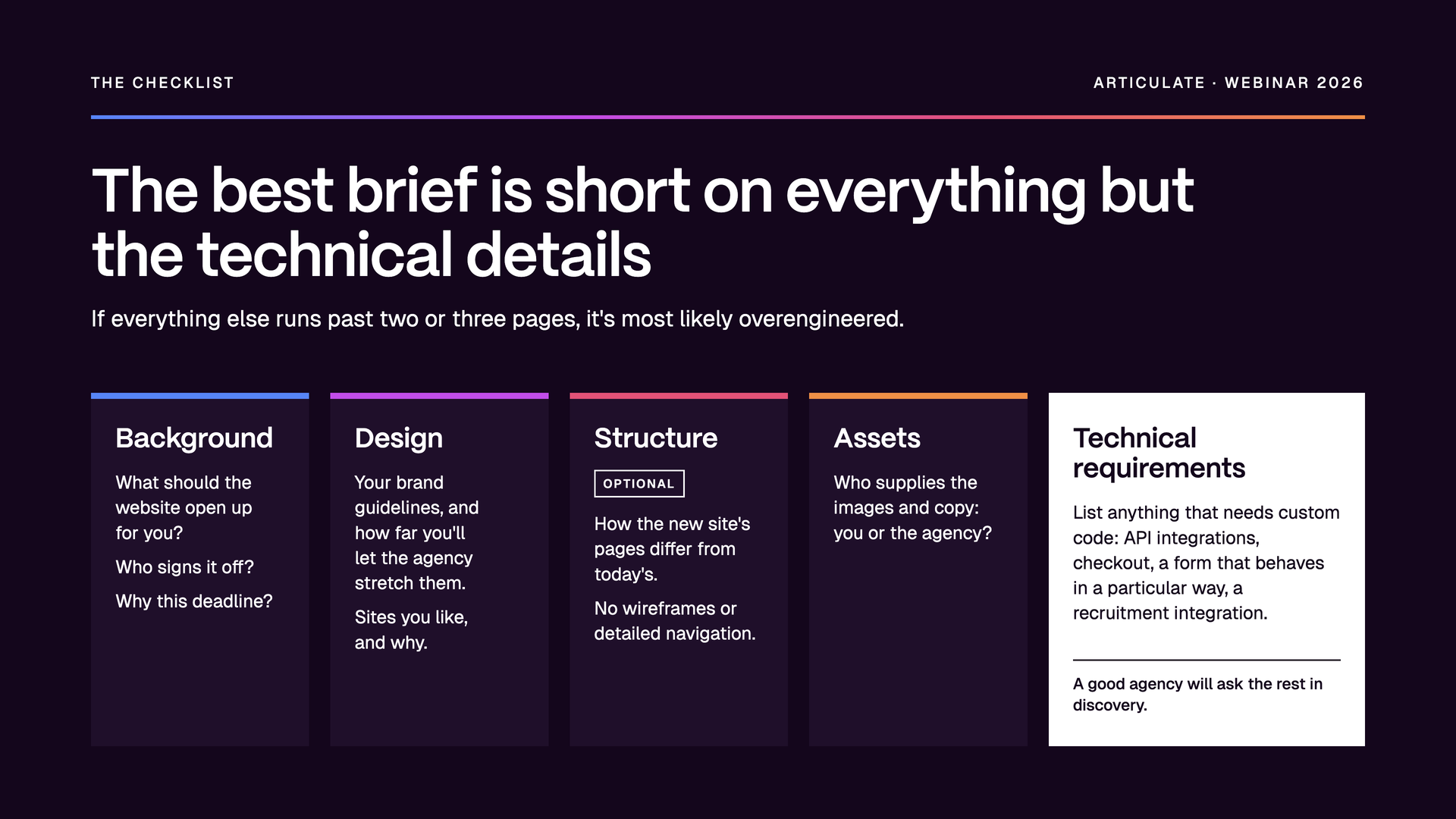
A good agency will ask the rest in discovery. If you want a prompt for the technical section, our website specification template lists the questions.
You'll know it worked when you've forgotten it
Ioana has two tests for a brief. The first is the 3am test. If someone wakes you in the night and you can't say what the brief for your website is, it has failed. That goes for the agency as much as the client. Long briefs fail it. Then, halfway through the project, someone remembers a detail on page 37 that nobody has mentioned since, and there is an uncomfortable conversation.
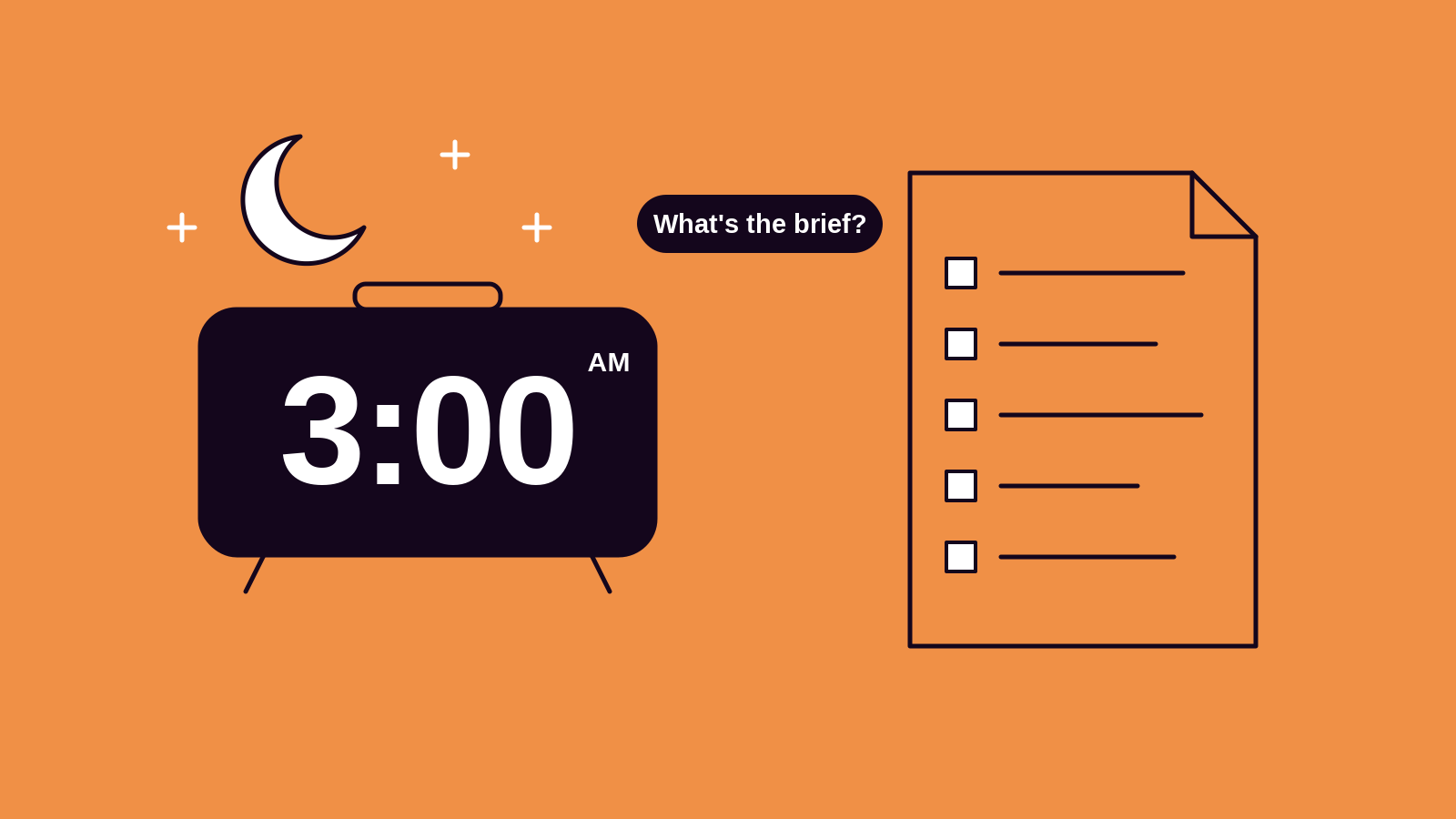
The second is the memory test. "The brief has worked if you have forgotten about it," she said. A brief is something you read before the project starts, so you can shape the process and ask the right questions. If either side has to check it before every meeting, something has been lost between the people.
Matthew draws the same line. "If it's a communication tool and a collaboration tool, brilliant," he said. "If it's a compliance tool or performative thing for an RFP, it's sort of failed."
Your website will be your digital home, as Ioana puts it, and you are going to live in it. You should launch one you love. So write the brief you could recite at 3am. Then start talking.
About to write a website brief? Talk to us before you write it, or before you get AI to write it. Book 30 minutes with Matthew and he will bring along the people who would build your site.