HubSpot announced 134 product updates at Unbound in Boston in mid-September. I read the lot, then spent 30 minutes on a webinar trying to make sense of them. This is the written version, with my opinions left in.Here's the video of the webinar and you can download the slides too. Alternatively, read on for an article version with additional links.
A quick declaration of interest. Articulate has been a HubSpot partner for well over ten years and we run our own business on it. So we watch what HubSpot does closely, and we are not neutral. But this is not a product demo or a pitch. If anything, it is a plea to think before you click.
One idea underneath 134 announcements
Strip away the product names and almost everything HubSpot launched hangs off a single idea, which it calls Growth Context: the business-specific understanding of your customers, products, CRM data, brand and processes that every AI agent reads before it acts.
HubSpot's own claim is that customers using AI with high-quality context see three-and-a-bit times as many MQLs and three-and-a-bit times as many deals won. Treat that as a claim rather than audited evidence. I have run analyses like this myself, including for Google, and you tend to find that well-run, well-marketed businesses do better whatever tools they use. But the underlying point stands: if the context is wrong, the work is wrong.
Twenty years of HubSpot in four acts
Pay attention to what companies call themselves. It is the clearest signal of where they think they are going.
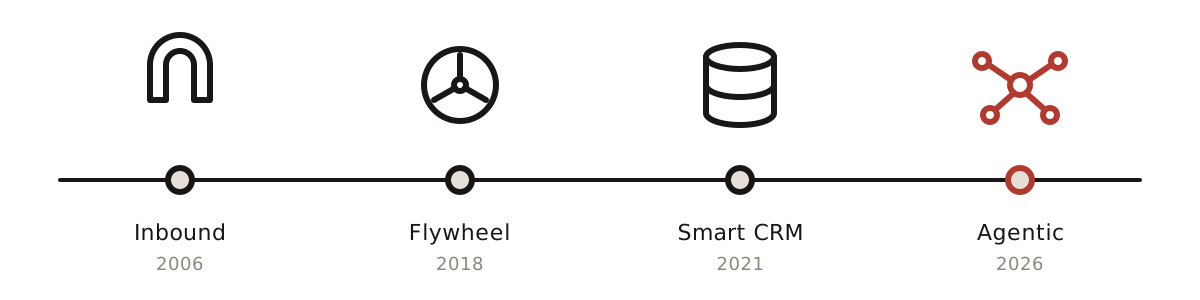
I remember sitting in a small room, 18 or so years ago, with Brian Halligan pitching inbound marketing to a couple of dozen agency owners. That was act one: a methodology first, software second. Act two was 2018, when HubSpot made a big song and dance about the flywheel and launched Service Hub; the customer experience became the growth engine. Act three has been the last five years or so: positioning the Smart CRM against Salesforce, with enterprise features, custom objects and a focus on data quality.
Now we are in act four. HubSpot describes itself, in its own words, as an "agentic customer platform". AI is no longer a layer or a go-faster stripe. HubSpot says it is the product. That is why the Breeze brand has been retired for everything except Breeze Assistant, the in-app chat. When the whole product is AI, a separate AI sub-brand implies AI is bolted on.
My one reservation about the new positioning is that it sounds like inside-out language. I am not sure many CMOs, and certainly not many CEOs, wake up thinking "what my business needs is an agentic customer platform". And HubSpot is not alone in the claim: Notion, Salesforce, the big model providers and a crowd of marketing tools are all saying some version of "give us your knowledge and we will give you AI". HubSpot still has a job to do connecting its technology story to something people care about.
Three layers, and where the meter sits
The most useful way to read the announcements is as three layers.
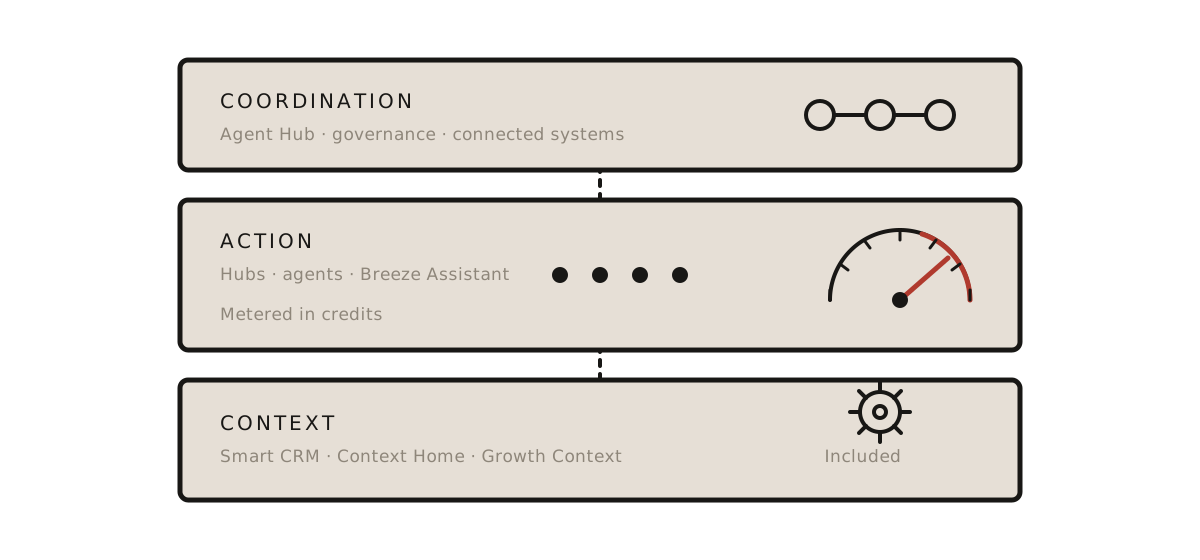
- Context. The Smart CRM plus the new Context Home. Where your customer understanding lives. Included in every plan.
- Action. The hubs, the agents, Breeze Assistant. Where the work gets done. This is where HubSpot now wants to charge for usage rather than access.
- Coordination. Agent Hub, governance, connected systems. Where humans manage agents and intervene.
The pricing point matters. For years HubSpot has charged per seat, per marketing contact and per hub. Now it wants you to pay for taking action, in credits. I am not convinced people are ready to pay for usage yet. Warren Buffett famously hung up his dial-up modem because he hated paying by the minute, and he was the richest man in the world. People do not like being nickel-and-dimed. Maybe we will all get used to it, but watch this space.
Context Home: the one thing to do this week
If you take one practical action from this post, make it this one. Go to your portal, switch on Context Home (check your beta and product updates if you cannot see it) and read it as a stranger would. Or, better, as an AI would.
Context Home is a single screen showing what HubSpot currently believes about your business, your customers, your team and your processes. It replaces the old AI data sources and brand settings and consolidates them. It is also the place to correct HubSpot when it is wrong.
Two design decisions deserve credit. First, values you lock are protected from automated overwrites. That matters because AI memory systems are very good at quietly updating themselves without anyone governing the change. Second, uploading a document produces suggestions for review rather than silent edits. Governance for AI context is still a young discipline and this is a decent start.
Alongside it, the CRM is becoming self-updating. Deal Progression (formerly Smart Deal Progression) now works from meetings, calls and emails. Persuading salespeople to update the CRM after every call is like persuading them to eat their vegetables. If the AI does it for them, good.
A small confession: we are advanced HubSpot users and advanced AI adopters, and we have not been using this. We keep our meeting transcripts and the conversations about them in Claude, then update HubSpot through its MCP connector. We will now look at whether to switch. It is a good illustration that HubSpot is no longer the only game in town for this kind of work, which brings me to the argument.
Agents are commodities. Context isn't
Agents are fast-moving capabilities that now exist everywhere. HubSpot has them. Notion has them. Salesforce announced its own set at Dreamforce the same week. You can run something close to a headless CRM from Claude. They are not perfectly interchangeable, but you can use different agents on the same data in the same way you can use different word processors on the same document.
What is not interchangeable is the context: your knowledge of your business and, because this is a CRM, your knowledge of every customer's support requests, surveys, marketing journey, downloads, purchases and payments. That is hard to move. It is also governable, which is a virtue. You can put a wall around it and apply GDPR to it.
That, I think, is why HubSpot has made Context Home central to the CRM, and why it has made it free. It wants the moat around your context to be a HubSpot moat. It is always worth noticing where HubSpot thinks the value is: things that are valuable to HubSpot tend to be included; things that are valuable to you tend to cost credits or seats.
Marketing Studio 2.0 and the credit-burning loop
For marketers, the headline is Marketing Studio 2.0, rebuilt and included with Marketing Hub Professional and above. It is a shared workspace for planning, campaigns and reporting that surfaces underperforming segments and unfollowed leads.
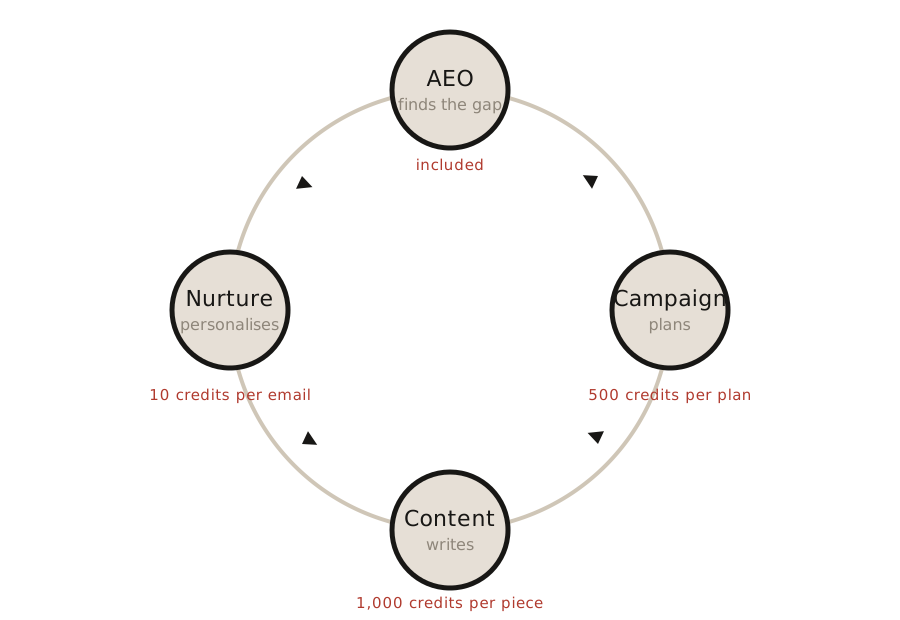
The story HubSpot is telling runs in a loop. AEO (included) spots a topic where you are not being cited by AI search. Campaign Agent plans a connected campaign from that gap. Content Agent writes the content. Nurture Agent rewrites each automated email per recipient at send time. AEO re-measures. If AI search visibility is new territory, our explainer on AEO in B2B marketing and the guide to getting cited by AI answer engines are the places to start.
Three of the four steps are metered: 500 credits for a campaign plan, 1,000 credits per piece of content, 10 credits per nurture email.
I have said plenty before about which marketing jobs to hand to AI and which to guard, and I am no Luddite. My theory is simple: AI plus competent marketers, planners and writers beats AI alone, and both beat no AI. The question is whether this particular AI, at this particular price, is where you want to spend.
Reading the meter
In the UK, 1,000 credits currently costs roughly eight or nine pounds, call it ten euros or ten dollars. These are approximate. So a HubSpot-written blog article is about £10 and a campaign plan is about £5.
Put that on a scale. You might pay hundreds of pounds for a professional to write an article, tens of pounds for an online freelancer, £10 for HubSpot's AI with some of your context, or nothing incremental to write it yourself in ChatGPT or Claude on a subscription you already pay for. That is the price range HubSpot is competing in.
Here is an anecdotal observation from looking across dozens of client portals: nine out of ten use zero credits. A couple burn a lot on buyer intent, usually in a blunt "get intent for everyone" way. And we are now deploying Customer Agent for three clients, which I think is the most defensible use of credits because you can justify the spend against sales handoffs or deflected support tickets.
HubSpot has added caps, so you can ring-fence, say, 10,000 credits for intent, 5,000 for Customer Agent and 5,000 for content. I am curious what happens the first time a Customer Agent deployment seen by hundreds of thousands of people a week runs out of credits mid-month. My geek memory recalls the move from on-premise servers to cloud computing. Per-hour compute looked cheap until the bills arrived. You pay for the mustard you leave on the side of the plate.
The open door
To be fair to HubSpot, the picture is more open than the credits story suggests. Nearly 8,000 agents are now connected to HubSpot through its MCP server. You can connect Claude or ChatGPT directly. You can create an API key and hand it to something you have built yourself. We do exactly this: a Claude connector with Claude skills, hooked up to HubSpot and Apollo, operated by talking to the AI of our choice.
The API changes announced at Unbound help too: date-versioned APIs with breaking changes twice a year, each version supported for 18 months, and much more granular scopes on the way. Developers who do not want to do everything inside HubSpot's agents can still get at HubSpot in a governed way.
So the model is splitting. The context layer is free and increasingly readable from outside, though a lot of Context Home itself is not yet exposed. The action layer, where HubSpot does the doing, is metered. It raises an interesting question: could someone one day run a sizeable business on a free HubSpot instance, with all the work done elsewhere through API access and cheaper models? I think HubSpot has to compete with that possibility.
And it raises the optionality and sovereignty questions that anyone deploying AI should now be asking. We are one political tantrum away from being told we cannot use this model or that model; it has already happened. A data breach, a price rise or a GDPR concern could push you towards a European model tomorrow. Do you want to buy AI retail, through HubSpot or Notion, or wholesale from the model providers? Or, for £6,000 to £8,000, buy a souped-up Mac Studio and run models locally with nothing leaving the building? If you are spending £500 or £600 a month on API tokens, that pays back inside a year.
Also on the truck
Briefly, because they are less relevant for most of our clients:
- HubSpot Work (beta) is an AI-first workspace for tasks, tables, documents and forms. HubSpot is tiptoeing towards Notion and Coda territory, arguing that proximity to CRM context adds value. Interesting if you run your business on Word and Excel. Not compelling enough to move if you are already on Notion, Asana or ClickUp.
- Revenue Agent (public beta) uses AI to chase unpaid invoices. Together with Revenue Hub, contracting and billing, it is a clear play for finance operations. Worth monitoring.
- ChatGPT Ads and Microsoft Advertising integrations. Historically, Microsoft Advertising was surprisingly good value; a click is a click.
- The AI Growth Bundle with OpenAI, aimed squarely at small businesses. After years of moving upmarket to fight Salesforce, HubSpot seems to have remembered the smaller end of the market.
The one urgent question
Every HubSpot customer, and every Articulate client, has AI ambitions. Put your arms around the whole of the Unbound pitch and it says this: AI activity across sales, marketing, service and revenue should happen inside HubSpot, both the context (where the information lives) and the processing (where the AI runs).
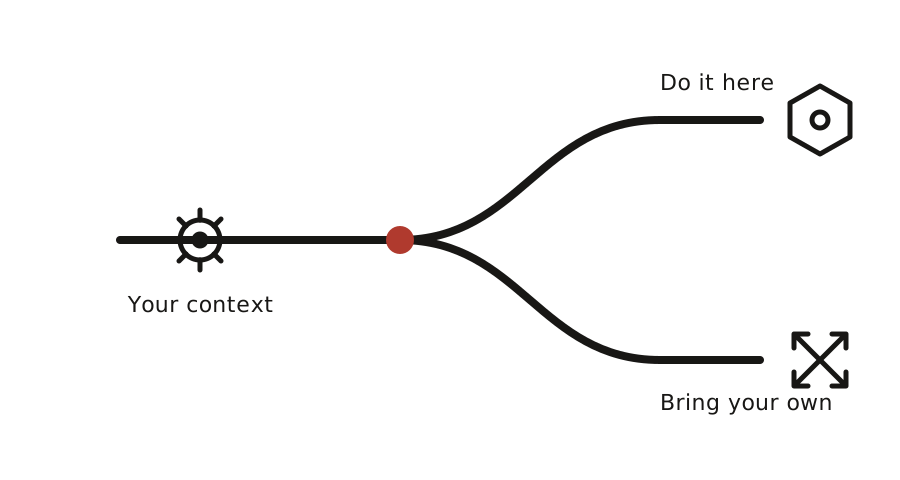 That might well be the right answer for you. One set of permissions, one audit trail, one governance model, no integration overhead. It is the old best-of-breed versus integrated-suite argument, and the suite has real advantages.
But there is a fork. Just as companies have historically run CRM in Salesforce and marketing in HubSpot, you might want your AI processing elsewhere, or your context elsewhere, or HubSpot's CRM records used as context for things that happen in another system.
My bias is to keep options open. Where HubSpot has an 80 per cent solution built in, as it does with Customer Agent, take it: it is easier and better than integrating something else. Where HubSpot is a 30 per cent solution and you have other reasons to look elsewhere, look elsewhere. And remember that everything true today may not be true in twelve months. The point is not which road you take. The point is to choose it deliberately rather than drift down one agent at a time.
Not thinking about it is the only wrong answer.
What to do this week
- Switch on Context Home, the self-updating Smart CRM features and Deal Progression. None of these costs credits.
- Simulate first. Before any metered agent goes live, test it, set a usage cap and read the audit log. Be especially careful with buyer intent: put a narrow cap on it so it does not eat your credits on day one of the month.
- Wait on HubSpot Work and Revenue Agent. Watch both; neither needs a decision yet.
- Ask the strategic question. Where should our context live, and where should our AI processing live?
Decide where your context lives. Everything else follows.
If you would like to talk through any of this for your own portal, email me at matthew@articulatemarketing.com or book 30 minutes directly. You can also read about our HubSpot automation and AI services, or catch up on last year's rundown of HubSpot's AI and automation features to see how far things have moved in twelve months.


