Most AI maturity models end in roughly the same place. At the bottom, people are experimenting with tools. At the top, the machine does almost everything while a human sits nearby, presumably holding the emergency stop button.
Campaigns, content, targeting, reporting, optimisation and production all disappear into an agentic black box. It is an efficient picture, but it sends marketing teams up the wrong mountain.
Marketing should not judge AI readiness by how close it is to switching the lights off and letting the machine run the department. That might satisfy a narrow view of productivity, but it does not fit a discipline where judgement, taste, originality, empathy and trust still shape the outcome.
A more useful question is whether AI is helping the team do better work. Speed has a role, especially when it clears repetitive tasks or removes production drag, but the goal should be a more valuable harvest, not simply a faster one.
Think of it like starting a farm in the simulation game Stardew Valley. You arrive with basic tools, a difficult patch of land and no obvious shortcut to success. You clear weeds, learn the systems, upgrade your tools, build routines and gradually create something that works. The best farm produces something valuable and reflects the skill, choices and personality of the person who built it.
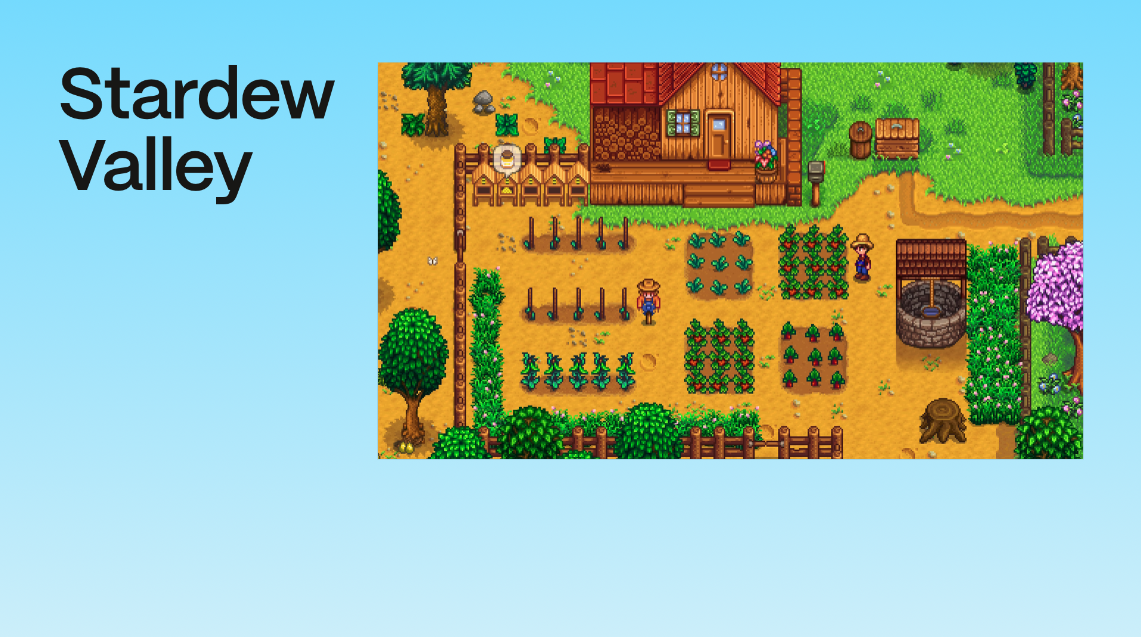
Marketing teams are in a similar place with AI. Everyone started with roughly the same tools, and everyone can buy access to ChatGPT, Claude, Mistral or whichever model looks clever this month. Advantage comes from the human skill you bring to those tools, not from secret access to a better machine.
AI readiness should make the work better
Many AI fluency frameworks treat maturity as a race towards maximum automation. The more the AI does without people, the more advanced the organisation appears.
That is a seductive idea when budgets are tight and everyone is under pressure to do more. It also risks turning marketing into a faster producer of forgettable work.
The better direction is human-led AI fluency. Let AI clear busy work, support thinking and make expertise easier to apply, while keeping people close to the parts of marketing that require judgement.
Time saved only has value when it is reinvested into the work that improves the outcome. That might mean sharper strategy, more thoughtful positioning, better creative development, richer customer insight, clearer briefs, stronger editorial judgement or more ambitious experimentation.
A team that uses AI to produce more average content may look productive for a while. A team that uses AI to create more space for better thinking is building a more durable advantage.
Before you score your team, it helps to separate three kinds of AI use.
- Getting the job done safely and competently.
- Getting the job done well, with stronger briefing, better review and clearer judgement.
- Using AI to do work that would otherwise be too slow, too expensive or too difficult.
The five tiers move through that progression. They start with rules and tools, then move through context, judgement, systems and finally differentiated, human-led work.
A good example is website prototyping. A static Figma mock-up still asks clients to imagine how a site will move, respond and feel. AI-assisted prototyping can turn the same thinking into something more interactive, so clients can click around, give better feedback and make decisions faster.
The value comes from combining AI with the team’s expertise. Designers still bring the judgement, practical understanding and knowledge of what can actually be built, but AI helps them present the idea in a more useful format.
Tier 1. Know the rules and the tools
The first tier is basic, but skipping it creates problems later. At this level, a marketing team understands which AI tools are approved, what people can do and are allowed to do with them and where the boundaries sit.
This is the Stardew Valley stage where you learn how to use the pickaxe, water crops and navigate the farm. It is not glamorous work, but the rest of the system depends on it.
A tier-one marketing team should have:
- An approved AI tools list
- Clear rules on company and personal accounts
- Guidance on confidential information
- Rules for personal data
- A process for adding or removing tools
- Basic training for common use cases
- A position on disclosure and communication
- Guidance on ethics and acceptable use
- Ownership of the AI policy
Practical details count. Do not put API keys into ChatGPT. Do not upload confidential client material into personal AI accounts. Do not add personal data without understanding the implications. Do not assume a tool’s default settings are in your favour.
The transcript gives one specific example. If you use HubSpot, check the AI settings and review whether data training options are switched on by default.
The purpose of tier one is to create a safe field for useful experimentation. Without shared rules, people improvise. Some will be careful, some will be fearful and some will make avoidable mistakes.
A company that hands everyone an AI account and hopes brilliance appears overnight has distributed risk rather than built capability.
Tier 2. Brief properly and provide context
Tier two is about how people use the tools day to day. The biggest difference between weak and useful AI output is often the quality of the brief.
A two-line prompt will usually produce something that looks confident. That does not make it useful. The output may be generic, shallow, wrong, off-brand or plausible in exactly the way that makes it dangerous.
A better AI interaction looks more like briefing a room full of talented interns who know a lot about the world, but nothing about your business. They need context, goals, audience, tone, constraints, examples and feedback. They need to understand what good looks like before they can help you get there.
A tier-two marketing team should be able to give AI:
- Background context
- Audience information
- The goal of the task
- Tone of voice guidance
- Brand rules
- Examples of good work
- Relevant source material
- Constraints and exclusions
- Success criteria
- Feedback across multiple rounds
Projects, skills, connectors and shared context become important at this tier. If every person has to build their own prompts from scratch, the quality will vary wildly. If the team has shared AI projects, reusable instructions and access to the right knowledge, the baseline improves.
A good prompt is rarely the whole answer. It is one step in a conversation. Strong users stay engaged, challenge the output, refine the direction and use AI to extend their thinking rather than outsource it.
There is a useful test for this tier. If your best AI user walked out tomorrow, how much of your team’s AI capability would leave with them?
When the answer is ‘most of it’, you have one skilled person rather than a team capability.
Tier 3. Bring judgement, taste and verification
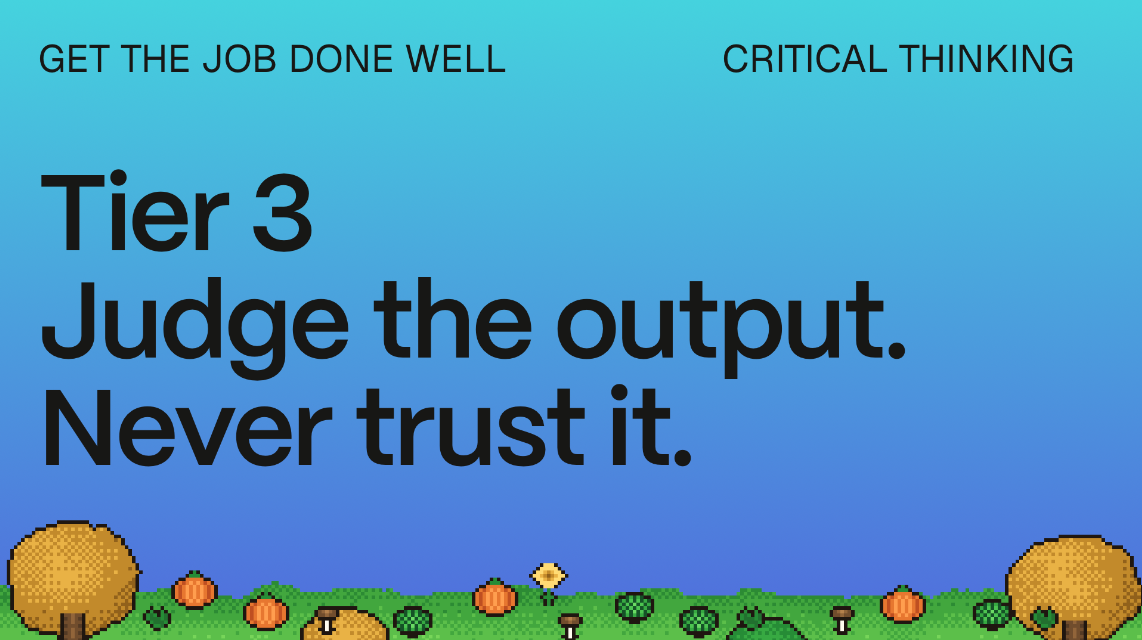
Tier three is where AI use becomes genuinely competent. People at this level do not trust the first answer. They treat it as a draft, a provocation or the first move in a longer process.
They check facts, verify names, test claims, compare sources and bring taste, judgement and experience to the work. AI begins to support better thinking, rather than only faster production.
A fluent AI user can look at a paragraph, slide, idea, code snippet or campaign concept and sense that something is off. They can spot generic thinking, tone drift, lazy reasoning, thin evidence or a structure that asks too much of the reader.
That ability comes from the person using the tool. The AI can generate an option, but the user has to know whether it is any good.
A tier-three team should have review habits built into the workflow, including:
- Fact-checking
- Source checking
- Peer review
- Second-pair-of-eyes approval
- Iteration records
- Draft comparison
- Clear quality standards
- A never-do list
- Named accountability for published work
Articulate’s own AI policy includes simple standards. Never assume the output is complete or accurate. Never quote AI. Always check your sources. Never send an AI draft unread.
At tier three, a team can say with confidence that AI-assisted work is still work they are proud to put their name on.
Tier 4. Build systems, not just prompts
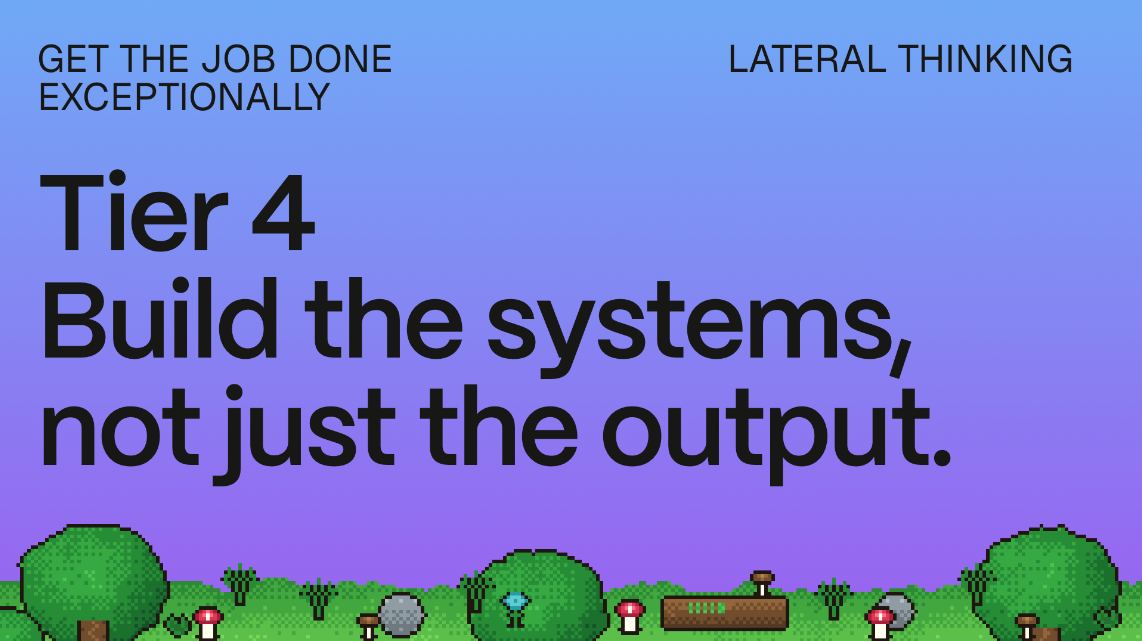
Tier four moves beyond individual prompting into systems thinking. The team starts asking which repeated AI interactions should become shared assets.
If people use the same context every week, it probably needs to live in a managed project, knowledge base or retrieval system. If people repeat the same task several times, it may need to become a skill, workflow or internal tool.
The aim is to stop valuable knowledge disappearing into private chats and one-off prompts.
A tier-four team might build:
- Shared AI projects for common tasks
- Reusable skills
- Brand and tone of voice libraries
- Retrieval systems connected to source material
- MCP or API connections into business tools
- Workflow automations
- AI-assisted reporting tools
- Structured review processes
- Internal knowledge bases
- Systems that combine AI with deterministic code
At this tier, AI becomes part of the operating model. It can connect to CRM data, sales transcripts, content libraries, brand guidance, campaign plans or website analytics. It can help analyse patterns, prepare recommendations and bring the right context into the right workflow.
Articulate’s webinar production system is an example. The team built a process that helps create webinar assets in HubSpot and saves around four hours a week. That time can then go into the thinking behind the webinar, rather than repetitive setup work.
Tier four also needs discipline. Once a team starts building systems, software-like habits become relevant. User acceptance testing, version control, monitoring, backup, permission management, access control, bug reporting and regression testing all matter when the business starts relying on the output.
Deterministic vs probabilistic systems
A useful tier-four skill is knowing which parts of the system should be deterministic and which parts can be probabilistic. A deterministic system gives the same output when it receives the same input, which is useful for repeatable production tasks such as building a webinar email from approved copy or generating campaign assets from a controlled template.
Probabilistic AI behaves differently. Ask an AI tool to write an email twice and it will produce two similar but different answers. That variation can be useful when you want ideas, synthesis, challenge or creative options, but it can be risky when you need consistency, compliance or exact repeatability.
A mature AI system often uses both approaches. You might use AI to help build a deterministic tool, embed AI into one stage of a controlled workflow, or use code to gather data, AI to summarise patterns and humans to interpret the result.
AI also changes quickly, so systems need maintenance rather than a one-off burst of enthusiasm. A workflow built in January may already feel clumsy by September. A tool that looked essential six months ago may now be bundled into a platform you already pay for, while a model that felt best-in-class may be overtaken.
Teams do not need to predict the next two years perfectly. They need to stay close enough to the edge to keep learning, with enough freedom to test ideas, enough structure to share what they learn and enough discipline to stop work that is not producing value.
Tier 5. Create space for human-led differentiation
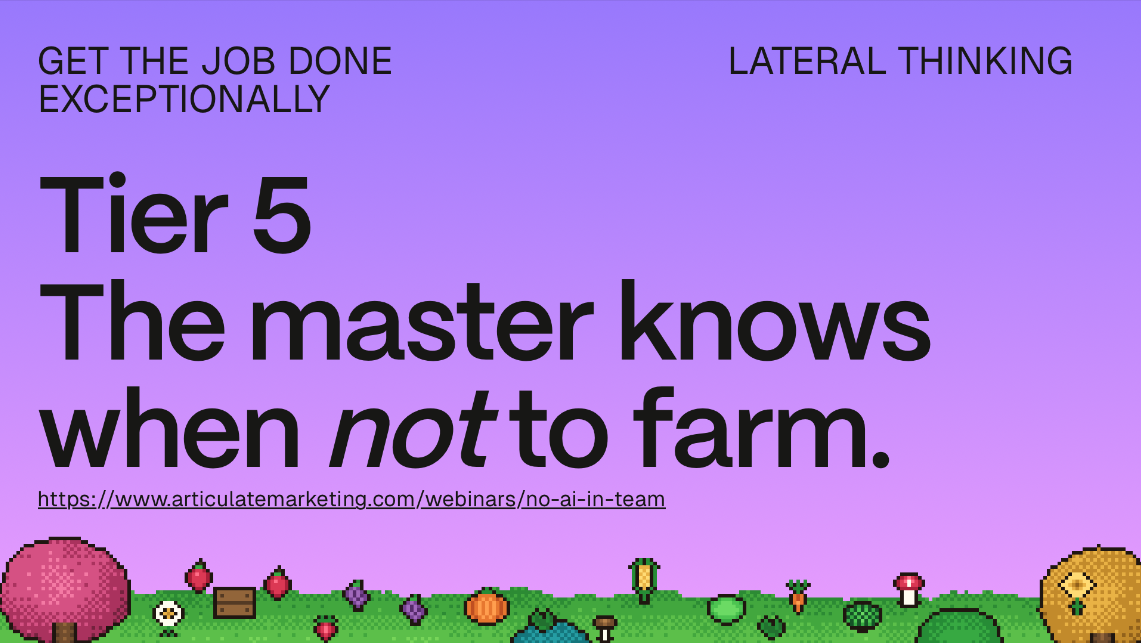
Tier five is the top of the mountain. The goal is to create more light and more space for human beings to do the work only human beings can do well.
At this level, AI has cleared enough busy work, supported enough systems and made enough knowledge available that people can choose where their effort goes. They can think harder, experiment more bravely and bring more of their judgement, expertise and experience into the work.
A tier-five team can ask better questions:
- What if we do not do this the usual way?
- What would make this genuinely useful?
- What would delight the audience?
- What are we assuming?
- What could we try now that was previously too expensive or slow?
- Where should we deliberately avoid AI?
- What human moment would make this more trusted?
- What would make the work unmistakably ours?
This is where AI supports differentiation. There are still things AI does not do especially well. It can simulate empathy, but it does not have lived human understanding. It can imitate stories, but it does not build trusted relationships in the way people do.
Buyers still respond to expertise, personality, rapport, trust and human presence, and tier-five teams know when the human is the point.
The five-tier self-assessment
Use the five tiers as a practical self-assessment for your team.
Tier 1. Rules and tools
The team knows which tools are approved, how to use them safely and where the boundaries are. There is clear guidance on data, confidentiality, personal information, ethics and acceptable use.
A team is not ready to move beyond this tier if people are using random tools with client data, relying on personal accounts or inventing their own rules.
Tier 2. Context and briefing
The team can brief AI properly. People provide audience, goals, tone, examples, constraints and source material. Shared projects, prompts and context help raise the baseline.
A team is still weak at this tier if most AI use consists of short prompts, generic outputs and private experimentation that nobody else can learn from.
Tier 3. Critical judgement
The team checks, challenges and improves AI output. People verify facts, review sources, edit carefully and apply taste. Important work does not go out unread or unreviewed.
A team has not reached this tier if AI drafts are treated as finished work, or if confidence in the output is higher than the quality of the review.
Tier 4. Systems thinking
The team builds shared systems around repeated work. Skills, workflows, knowledge bases, connectors and deterministic tools help make good practice repeatable.
A team is immature at this tier if useful prompts and processes live only in individual chats, or if internal AI tools have no owner, testing, permissions or maintenance.
Tier 5. Differentiated, human-led work
The team uses AI to create space for better thinking, stronger creativity and more distinctive work. Human judgement, expertise and experience become more visible, not less.
A team has not reached this tier if AI is mainly used to produce more of the same work, only faster.
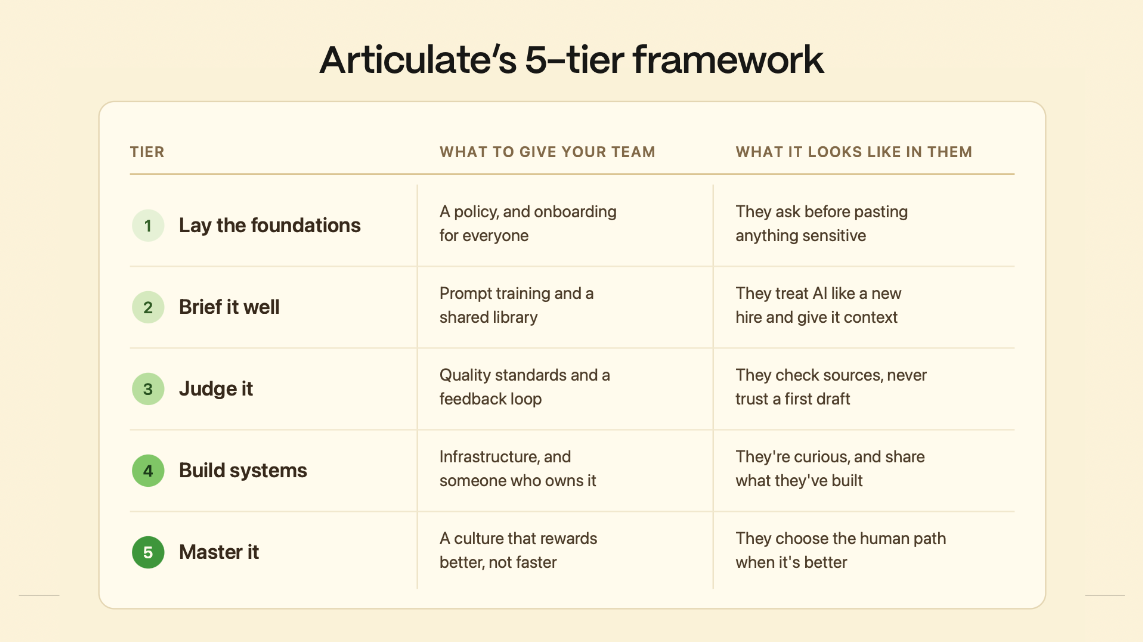
What your score tells you
Ask people to score the team from one to five, then ask them to score a normal working day. Do not use the best day or the impressive project everyone remembers. Use a normal Wednesday, when there are meetings, deadlines, fiddly tasks, half-written briefs and a bit of rain in the air.
That second score is probably more honest.
Then ask:
- Do we have clear rules and approved tools?
- Do people know what data they can and cannot use?
- Are our best prompts and methods shared?
- Do people give AI enough context to do useful work?
- Do we review AI output properly?
- Can we measure the quality of the work?
- Are we building reusable systems, or repeating private workarounds?
- Do our AI tools have owners?
- Do we know what should be deterministic and what can be generative?
- Are we using AI to make the work better, not just faster?
- Are we creating more space for human judgement?
- Do we know where not to use AI?
The answers will give you a clearer picture of the team’s real fluency. They may also show that the gap is not tool access, but shared practice, review discipline or the lack of reusable systems.
Better work, with better tools
The question is not how many tools your team has bought, how many prompts people are writing or how quickly another draft can be generated. The better test is whether AI is improving the quality of the work, making expertise easier to apply and giving people more room to think.
At the highest level, AI-assisted marketing should still feel human. The person using AI brings the judgement. The team brings the standards. The organisation brings the culture, systems and appetite for learning.
AI brings speed, synthesis, pattern recognition and new capabilities, but it cannot supply your experience, humanity or point of view. Those are the valuable things on the farm. No one can sell them to you, and AI cannot replace them. The real work is learning how to use AI to maximise them.
Want to make AI work harder for your marketing team?
If your team is trying to move from ad hoc experimentation to a more fluent, human-led AI practice, a conversation can help. We can look at where your team is now, where AI could remove friction and what would help you use it with more confidence.
Book a free 30-minute Marketing Strategy Session with Articulate founder Matthew Stibbe.


