.jpg?width=64&height=64&name=1694622801428%20(1).jpg) Posted by
Sian Cooper
Posted by
Sian Cooper
This article shares the high-level takeaways from a webinar run by our CEO and Founder, Matthew Stibbe. To catch every pearl of wisdom, watch the full webinar (gated content).
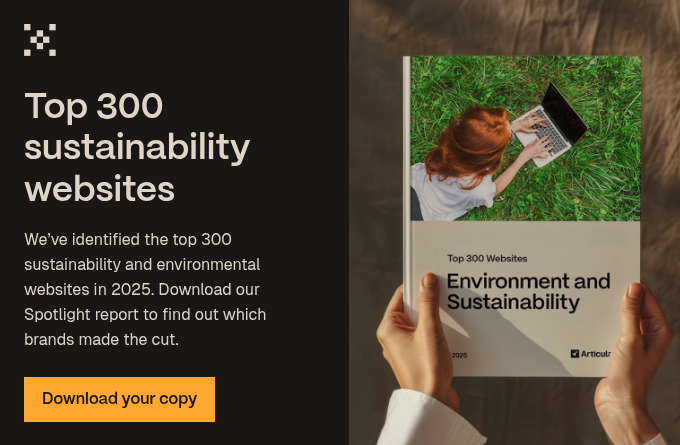
What makes a sustainability website ‘good’? And what can sustainability marketers do to elevate their websites? We explored 300+ sustainability websites to find out. Here’s a snapshot of what we found. Want to understand our methodology and read the full report? Download your copy of Spotlight - Top 300 Websites - Environment and Sustainability Edition 2025 here.
Design matters: visual identity findings
Good design is about more than appearance alone. Here’s what we observed among the top 20 sustainability sites.
- While most sites favour greens and clean design, the best distinguish themselves with richer palettes (even if only in their secondary colours and accents).
- Modular, repeatable layouts are popular, emphasising the importance of sites that are easy to manage and update.
- Simplicity can spill into design, with several ‘wordmark-only’ logos that lack supporting icons. But bespoke illustrations and custom header fonts are what make websites memorable.
- Low-contrast colour palettes can fade CTAs into the background, while high-contrast logo and wordmark weights can be jarring and distracting. Visual harmony matters.
- When it comes to typography, hierarchical inconsistency interrupts the reading rhythm and heavy heading weights can impact legibility.
- Pairing real-life photography with tech product or user interface (UI) visuals cleverly mixes the familiar with the futuristic.
Speaking the language of sustainability: verbal identity insights
The broader your audience, the more precise your language needs to be. Here’s how the top 20 websites communicate.
- We found a 60:40 split in professional vs informal tone of voice (TOV). Whichever you lean into, a strategic and well-documented mission, vision, values, key messages and TOV should underpin every sentence you write.
- The best sites say what the audience needs to know, not just what internal stakeholders think it should say. Don’t bury the lead!
- We love playful, memorable language like ‘Beetroots, beans and beyond’ (Oddbox) and ‘We do enhanced rock weathering’ (UnDo).
- Top sites write with accessible, clear language. Use direct calls-to-action (CTAs) if you want to turn clicks into leads and back your mission with data, proof points, testimonials, stats and quotes**.** Remember that decision-makers in 2026 need to demonstrate ROI.
- Many favour simplicity when it comes to brand personality, but playful language helps balance technical explanations. Say less and do more by replacing big blocks of prose with simple, actionable copy.
Built to last: site performance and structure analysis
When your mission is critical, your site needs to be performant and your structure needs to be slick. The top 20 do this well, but there’s still significant room for improvement.
- 90 per cent of the top 20 sites need to improve their load times.
- Fewer than half achieved high accessibility scores on both mobile and desktop.
- Intuitive user experience (UX) is crucial. Websites must guide their visitors with conversion-focused language and high-contrast CTAs that are hard to ignore.
- Successful websites fuel their content hubs with dedicated resources, regular updates, agility and diversity. Prioritise rich resource hubs.
- The very best focus on conversions. Impactful websites are always built with conversion-rate optimisation (CRO) and user behaviour in mind.
- SEO is stronger among the top performers, with 14 out of 20 sites performing well.
Want to build a successful, purpose-driven website that tells your story, speaks your audience’s language, looks the part and drives leads? We can help. Book a free 30-minute marketing review with one of our consultants.


.jpg?width=100&height=100&name=1694622801428%20(1).jpg)

.jpg?width=400&height=250&name=europeana-84R6ipsqaxo-unsplash%20(1).jpg)